Are Avoidant Personalities Avoidantly Attached?


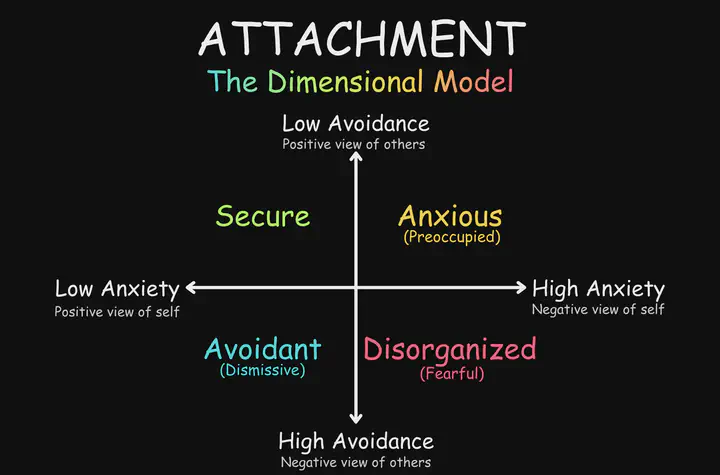
One thing that has really stuck out to me when researching Avoidant Personality Disorder is that it overlaps with two opposite personalities: schizoid (social isolation, introversion, difficulty with intimacy) AND dependent (feeling inadequate, needing reassurance and closeness, hypersensitive to criticism)1. Schizoids detach from people, and dependents attach to people…so how do avoidant personalities overlap with both?! This can be investigated from the lens of attachment theory. When we think about how avoidant personalities are attached, we obviously believe they are avoidantly attached… Avoidant Personality = Avoidant Attachment…right? ❌WRONG! …But first, let’s talk about what attachment actually is.
What is Attachment? 2
Attachment is the bond between a primary figure and an infant that influences the infant’s internal working model, which is basically a map of how the self and others are viewed. The classic model of attachment stems from the strange situation experiment, which resulted in three categories of attachment: secure, anxious, and avoidant, the latter two being insecure attachments. Later, attachment theory was applied to adults, with a special caveat that adult attachment is reciprocal caregiving and can change/co-regulate depending on attachment behaviors such as perceived support, accessibility, responsiveness, and engagement.
The Four Attachment Styles 2
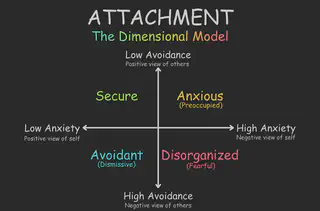
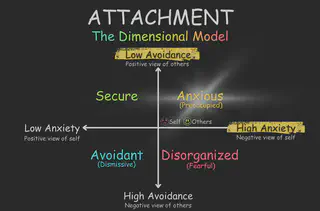
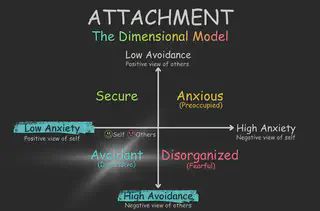
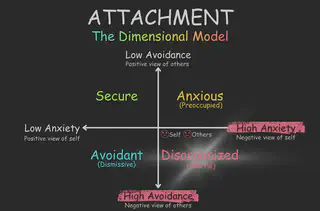
More recent research determined that attachment is not categorical, but is made up of two factors: anxiety and avoidance, in which you can be high or low on either. This dimensional model results in four quadrants: secure, anxious (preoccupied), avoidant (dismissive), and disorganized (fearful)…but also these categories have been called so many different names!
Secure Attachment…⬇️avoidance, ⬇️anxiety
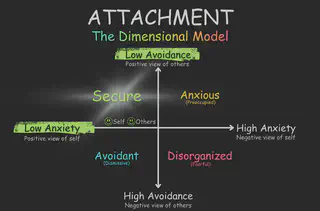
Securely attached infants were distressed by separation from their mothers and could receive comfort when she returned. In adulthood, there is low avoidance and anxiety, resulting in a positive view of the self and positive view of others, which means they are confident in themselves and in their partner’s availability and responsiveness. Secure attachment is related to positive adjustment outcomes, such as relationship quality and relationship satisfaction. They are comfortable with intimacy and interdependence. They are more adept at regulating their distress and regaining emotional well-being, and when needed, they’re able to do so by relying on partners for comfort and support.
Anxious (Preoccupied) Attachment…⬇️avoidance, ⬆️anxiety
Anxiously attached infants were distressed by separation and could not be comforted when the mother returned. They had inconsistent or mixed support and care in childhood, resulting in high desire for closeness and acceptance. In adulthood, there is low avoidance and high anxiety, leading to a negative view of the self and positive view of others. They really struggle with dependence and fear of abandonment, needing to move toward their partner. They tend to have persistent worries about their partner’s availability, commitment, support, and responsiveness, fearing abandonment and rejection, especially when faced with threat or in times of need. This results in a high sensitivity to rejection cues. Research tells us the following examples of anxious attachment behavior: drawing attention to their distress; expressing heightened distress; continually seeking closeness/proximity; pulling for excessive closeness, comfort, and care; excessive demands for reassurance from partners; and being overly sensitive to potential cues that would threaten the relationship.
Avoidant (Dismissive) Attachment…⬆️avoidance, ⬇️anxiety
Avoidantly attached infants were not distressed upon separation and avoided the mother when she returned. They were rejected and/or dismissed in childhood, resulting in core schemas that others cannot be trusted or relied upon. In adulthood, avoidant attachment is high in avoidance and low in anxiety, resulting in a positive view of the self and negative view of others. They really struggle with withdrawal and fear of intimacy, moving away from their partner. They tend to have discomfort with closeness and dependency, preferring emotional distance and self-reliance. This leads to withdrawal behaviors such as minimizing distress, averting attention away from threats, overly relying on self, limiting negative appraisals of the self, being defensive, distancing from others, denying the importance of intimacy, and suppressing vulnerability and weakness.
Disorganized (Fearful, Fearful-Avoidant, Anxious-Avoidant) Attachment…⬆️avoidance, ⬆️anxiety
Disorganized attachment style was a new addition to the classic model, as some children were just coded as “unclassifiable.” Infants did not have a coherent way of interacting with their mother during stressful times, exhibiting confusion, fear, and approach-withdrawal behaviors. Disorganized attachment in adulthood consists of both high avoidance and anxiety, resulting in a negative view of both the self and others. There can be a push-pull dynamic where there’s movement toward and away from their partner, depending on the situation. They experience conflicting desires between wanting closeness and fearing it, so their behavior becomes contradictory…hence, disorganized.
What Does the Research Say About Avoidant Personality and Attachment?
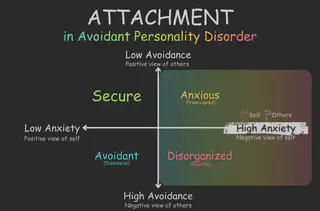
Overall, personality disorders are breakdowns in attachment involving intense difficulties relating to the self and others. Personality disorders are correlated with insecure attachment, but specific attachment is not predictive of individual personality disorders. According to the DSM-5-TR, those with avoidant personality disorder have insecure attachments: wanting closeness and emotional attachment, but fearing closeness because others might reject or hurt them. Then, they respond with fear, anger, or passivity3. Interestingly, those with avoidant personalities fear abandonment and experience separation frustration4. Research indicates avoidant personality disorder is usually associated with “preoccupied” (anxious) or “fearful” (disorganized) attachment3 4. However, it has been proposed that those with avoidant personality disorder might have an avoidant attachment shell with an anxious attachment core, making it possible they test as avoidant (or disorganized), but are actually anxiously attached4.
Early Childhood and Avoidant Personality Disorder 1 5
Those with avoidant personality disorder are more likely to remember their parents as rejecting, guilt-engendering, less affectionate, overprotective, and less encouraging of achievement. They also have a higher likelihood of childhood traumas, parental divorce, parental neglect, and “early maladaptive strategies,” but not as much sexual abuse or physical neglect - so more emotional and psychological stuff. There was also an association with “Onlooking Behaviors” where the kiddo observes others and wants to engage, but is too anxious to try to join1.

🚨Spoiler alert: Antisocial personality is up next, so I found a bit about attachment and antisocial personality disorder. Some research noted antisocial personality disorder trends toward avoidant attachment6, but some found anxious attachment too7. There’s also talk of antisocial personality disorder being a disorder of attachment!7 6 One more nerdy nugget: McWilliams8 highlights that those with antisocial personalities don’t attach to a primary figure, but rather have a failure in attachment and perhaps might identify with an archetypal idea.
Attachment is complex! Let us know your experiences on YouTube or contact us here! If you want to dive into your own attachment or the attachment dynamics of someone in your life, therapy and/or psychological testing can help! If you’re in Virginia (or a PsyPact state), check out our private practice, Quest Psychological and Counseling Services for available services. If you’re a provider stuck on a case, we also offer consultations for mental health professionals!
References
Lampe, L., & Malhi, G. (2018). Avoidant personality disorder: Current insights. Psychology Research and Behavior Management, Volume 11, 55–66. https://doi.org/10.2147/PRBM.S121073 ↩︎ ↩︎ ↩︎
Fisher, C. (2018). Attachment and God image (Publication No. 10978640) [Doctoral dissertation, Regent University]. Proquest Dissertations & Theses. ↩︎ ↩︎
American Psychiatric Association. (2022). Diagnostic and statistical manual of mental disorders: DSM-5-TR (5th edition, text revision.). https://doi.org/10.1176/appi.books.9780890425787 ↩︎ ↩︎
Eikenæs, I., Pedersen, G., & Wilberg, T. (2016). Attachment styles in patients with avoidant personality disorder compared with social phobia. Psychology and Psychotherapy: Theory, Research and Practice, 89(3), 245–260. https://doi.org/10.1111/papt.12075 ↩︎ ↩︎ ↩︎
Zhou, N. (2024). Avoidant Personality Disorder: A Review of Features, Performances, and Treatments. SHS Web of Conferences, 193, 03001. https://doi.org/10.1051/shsconf/202419303001 ↩︎
McGauley, G., Yakeley, J., Williams, A., & Bateman, A. (2011). Attachment, mentalization and antisocial personality disorder: The possible contribution of mentalization-based treatment. European Journal of Psychotherapy & Counselling, 13(4), 371-393. https://doi.org/10.1080/13642537.2011.629118 ↩︎ ↩︎
Beeney, J. E., Stepp, S. D., Hallquist, M. N., Scott, L. N., Wright, A. G. C., Ellison, W. D., Nolf, K. A., & Pilkonis, P. A. (2015). Attachment and social cognition in borderline personality disorder: Specificity in relation to antisocial and avoidant personality disorders. Personality Disorders: Theory, Research, and Treatment, 6(3), 207–215. https://doi.org/10.1037/per0000110 ↩︎ ↩︎
McWilliams, N. (2011). Psychoanalytic diagnosis: Understanding personality structure in the clinical process (2nd ed.). Guilford Press. ↩︎
