The 3 Unstable Personalities
The 3 Unstable Personalities
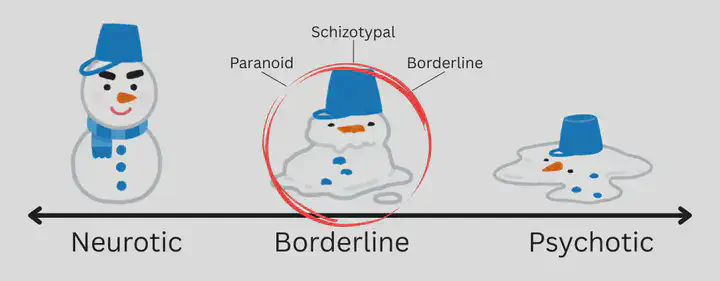
** For this blog, the borderline personality organization (note: this is not BPD!) is super important to understand because Millon noted this is where his structurally defective personalities are found. Please see Understanding Neurotic, Borderline, and Psychotic Personalities for more detail **
Millon’s Structurally Defective Personalities 1
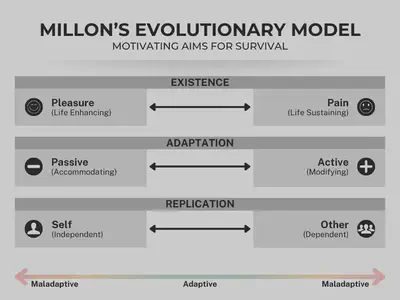
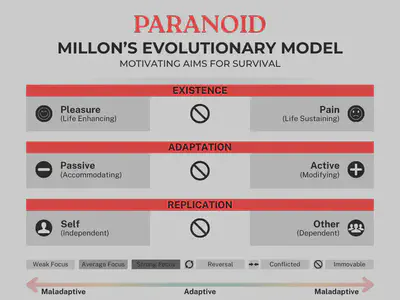
Millon categorized three personality disorders as more severe than the others because they are “structurally defective,” meaning that the actual architecture of the psyche - not the style/category of personality - is unstable and falling apart. It’s “melting,” like the borderline organization mentioned above. While all humans have survival motives, personalities look differently in regard to balance and conflict of needs (see picture above). These three personality disorders are: Schizotypal, Borderline, and Paranoid.
Schizotypal Personality - Ungrounded 1
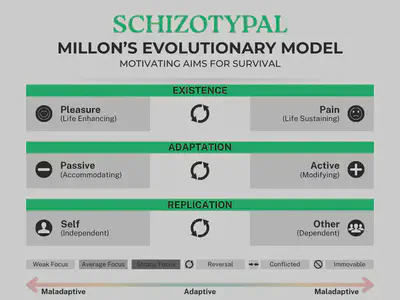
I won’t go into detail about what Schizotypal is here, but if you need a recap on schizotypal personality, check out this blog. The unstable aspect of the schizotypal involves the fragility and disconnection to their survival motives, like a leaf floating all around with no purpose or effectiveness. Thus, their focus on the polarities are easily reversed and always muted and weak.
Some major signs of schizotypal at the borderline organization (aka almost psychotic-ness) include cognitive slippage, odd perceptual experiences (bodily illusions, detachment from body), preoccupation with “other worldly” phenomena (e.g., superstition, magical thinking, telepathy), and ideas of reference (e.g., thinking “They are talking about me because they looked at me as they drove by”). Sometimes, there can be brief steps into actual psychosis, but it doesn’t stay there. It’s their ungroundedness and disconnect from self and the world that leads them to the quasi-psychosis place.
For structurally defective personalities, there is almost always another non-structurally defective personality disorder that goes along with it. Though, it can be difficult to know what the original structure used to be before it started falling apart. For schizotypal, schizoid (passively detached) and avoidant (actively detached) personalities are usually the ones that disintegrate and fall apart into schizotypal.
Borderline Personality - Conflictual 1
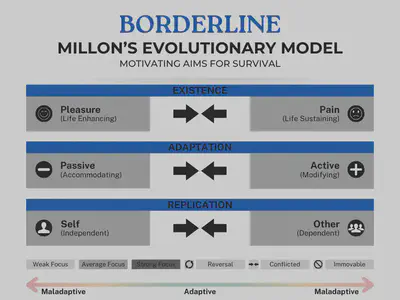
Here, we are discussing borderline personality disorder, not borderline personality organization (though it is at the borderline level of organization - so “double borderline,” if you will). If you need a recap on borderline personality, check out this blog. In regard to the survival motivations in Millon’s theory, borderlines have an average focus on each, but there is a conflict within each domain. There is intense, extreme inconsistency and ambivalence, resulting in emotional lability, unpredictable behaviors, and thoughts/feelings about others that are always changing and inconsistent. They keep switching back and forth between the different survival polarities, which is often why there tends to be push-pull dynamics in borderline personalities (e.g., “Come here - Go away,” “I love you - I hate you,” or “I want help - I don’t need your help”). The bottom line: They are unstable.
Some major signs of a borderline’s almost psychotic-ness include stress-triggered, fleeting dissociation or paranoid ideation, which may or may not briefly cross into actual psychosis with hallucinations and delusions. But they come back to reality quickly and are aware of their brief stay in psychosis. Borderline personalities can be extremely aware of their psychic pain, to a fault. There may be temporary dissociative episodes ranging from wasting the day away in bed to self-harming without feeling pain. There can be short-term paranoia about others being out to get them, resulting in impulsive and reckless decisions like moving to a different state, quitting their job, or leaving a relationship.
For the structurally defective borderline personality, the other personalities that often coexist with it include those historically in Clusters B and C: melancholic (sad), dependent (clingy), avoidant (socially anxious), histrionic (attention-seeking), narcissistic (egotistical), and antisocial (rule breaking).
Paranoid Personality - Rigid 1
If you need a recap on paranoid personality, check out this blog. For the paranoid, Millon doesn’t focus on the intensity of motives, but the inflexibility and rigidity of the paranoid’s survival aims and motives. Their psychic structure is fixed, so whatever they learned and developed in life is hidden, unchangeable, and not influenced by life circumstances and external experiences. There is an unwillingness to change, even with good reasons to do so or when faced with contradicting information. They will not adapt to external realities, rigidly adhering to their way of viewing the world, which they see as a hostile and threatening place. Paranoids are so afraid of annihilation that they are fixated on surviving, causing them to freeze.
Paranoids dip into brief psychosis is actually super tricky to see because their delusions are systematic, meaning they are logical and comprehensive, but also irrational and untrue. Often, the delusion is persecutory, as they are absolutely convinced someone is out to get them with malevolent intent, despite no evidence or evidence to the contrary. Usually, this is triggered by intolerable, unconscious feelings of guilt that are then projected onto another (“I’m not the bad guy, YOU ARE”). They need to hurt before they are hurt, which can blur the line between self/others and reality/non-reality. It can also result in illusions of enemies, persistently bearing grudges, or believing the other completed an offense against them that did not happen. It’s their paranoia that takes them into possible psychosis.
For the structurally defective paranoid personality, other personality disorders that often coexist include avoidant (socially anxious), negativistic (passive-agressive), compulsive (extra rigid), narcissistic (egotistical), antisocial (rule breaking), and sadistic (dangerous). Because the three structurally defective personalities are falling apart and in a quasi-psychotic space, it can be extra difficult to differentiate them, especially because they usually coexist with a non-structurally defective personality.
Personality dysfunction and disorders can be tricky! If you want to better understand the differences between schizotypal, borderline, and paranoid, therapy and/or psychological testing can help! If you’re in Virginia (or a PsyPact state), check out Quest Psychological and Counseling Services for available services. If you’re a provider stuck on a case, we also offer consultations for mental health professionals!
References

Doc Fish
Licensed Clinical Psychologist
I am a licensed clinical psychologist who specializes in personality, attachment, and psychodynamic treatment.