Schizotypal Personality Subtypes (Millon)
Schizotypal personality disorder is a more recent personality disorder in the DSM, coming on the scene in the DSM-III in 1980 when schizoid personality disorder was separated into schizoid, avoidant, and schizotypal personality disorders. Interestingly, Millon’s schizotypal personality subtypes follow an avoidant line and a schizoid line (see picture below). Millon considers schizotypal personalities to be “structurally defective,” meaning the structure or architecture of the psyche can start to fall apart. He considers the severe level to decompensate into psychosis, so schizotypal personalities are more likely to be diagnosed with schizophrenia.
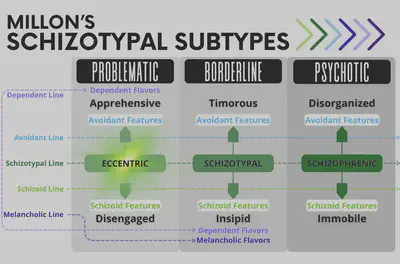
Eccentric Personality: Mild - Problematic Level 1 2
Unlike non-structurally defective personalities, schizotypal’s mild level isn’t necessarily closer to normal functioning, but rather, abnormal, and likely close to disorder level functioning. However, at this level, they can function adequately in society at times. They may have one or two DSM criteria and might seem unusual in their ordinary life, including sleeping, eating, and socializing in a way that is countercultural. But they don’t manifest obvious pathological features. So, let’s start with Millon’s mild subtypes of schizotypal personality, which he labeled as Eccentric (instead of Schizotypal): The “Disengaged” subtype and the “Apprehensive” subtype.
Disengaged (Schizoid Features) 1 2
The Disengaged Eccentric subtype includes some schizoid features, obvious in their passive detachment, as they have difficulty with eye contact and are often emaciated due to detachment from the body and hunger. They are also disconnected from their thoughts, or only loosely connected to them. They come across as strange, perhaps having unkempt hair, dressing in an odd fashion, and moving in weird ways. Their communication is just a little off, along with their facial expressions. They are withdrawn and uncomfortable around people, but observant of them. They live on the periphery of society.
Apprehensive (Avoidant, Dependent Features) 1 2
The Apprehensive Eccentric subtype overlaps with avoidant features and can also include some dependent features. They are more actively detached out of fear versus passively detached. They’re aware of their chronic, underlying anxiety and are easily overwhelmed. There exists a tension between their desire/need for a relationship, juxtaposed with their intolerance of people. They feel trapped in the conflict since they can’t handle it. So they choose to detach and actively avoid fearful things, especially social interactions.
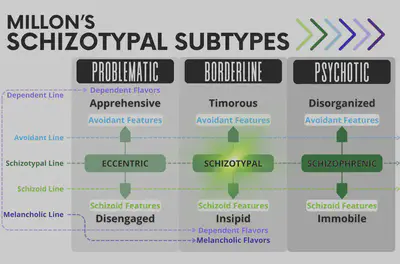
Schizotypal Personality: Moderate - Disorder Level 1 2
Millon’s structurally defective personalities express disordered personality at the moderate level. He notes that this matches up with psychodynamic’s borderline organization of personality (a place in between neurosis and psychosis). So even though we’re at the moderate level, we actually get into the territory of schizotypal personality disorder here…which is probably why Millon named this level “Schizotypal,” and he highlighted two subtypes called “Insipid” and “Timorous.”
Insipid (Schizoid Features, and sometimes Melancholic and Dependent Flavors) 1 2
The Insipid Schizotypal subtype overlaps with schizoid features, and can also have some melancholic and/or dependent flavors. They really lean into the passive detachment of schizoids, being emotionally bland/insensitive, behaviorally sluggish/inexpressive, socially unengaged/odd, and cognitively obscure/vague. Others can see them as strange, lost, and self-absorbed, as they are internally focused with more negative symptoms - so much so that their split between the mind and body can result in an intense fear of feeling nonexistent! Their slip into brief periods of psychosis is usually triggered when they are overstimulated/intruded upon at a level they can’t handle. Then, they can either explode - a frantic burst of activity aimed to shield the intrusion forced on them - or implode - a fading out, detaching from conscious awareness, and turning off the pressure of the external.2
Timorous (Avoidant Features) 1 2
The Timorous Schizotypal subtype overlaps with avoidant features, having a more active detachment and more positive symptoms. They are restrained, isolated, apprehensive, suspicious, guarded, and shrinking, sometimes even abandoning their own feelings, desires, impulses, and needs. They can’t find comfort in others, but also find no refuge in themselves - only shame, despair, and a devalued sense of self. Their apathy stems from protective attempts to push down their hypersensitivity to avoid the anguish of life and relationships. This results in an empty void that they actively fill with excitable, bizarre behaviors, speech, and hallucinations, all in an attempt to reassure themselves that they are alive…which doesn’t work in the long term, so they “intentionally” substitute fantasy for rational thinking to avoid the pain of realistic thought. However, they are often “shamed” back to reality. Their fantasies can involve safe persons/objects in attempt to obtain a “pseudocommunity.’’
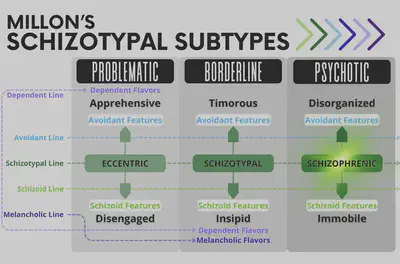
Schizophrenic Personality: Severe - Psychotic Level 1 2
Again, different from non-structurally defective personalities, the severe level here showcases a deteriorated personality that has fallen into chronic psychosis. Here, schizotypal personalities decompensate into schizophrenia. Millon differentiates between “Immobile” Schizophrenics and “Disorganized” Schizophrenics.
Immobile (Schizoid Features) 1 2
The Immobile Schizophrenic subtype showcases schizoid features including lethargy, indifference, apathy, listlessness, and stuporousness. They also present with drab clothing, a lifeless/masklike face, and slow, labored, and whispered/inaudible speech. Their schizoid-ness means the presence of passively detached negative symptoms like anhedonia and possibly catatonia (perhaps aligning with the previous DSM-IV-TR catatonic subtype of schizophrenia?). They are so passively detached that they seem (or are!) unresponsive to their environment and pain. It’s a protective withdrawal to avoid the anguish of life.
Disorganized (Avoidant Features) 1 2
The Disorganized Schizophrenic subtype overlaps with avoidant features, being more actively withdrawn, which includes more positive symptoms such as delusions and hallucinations. They seem lost, scattered, and confused with fragmented and diffuse thoughts, even having difficulty distinguishing between what is relevant and what is irrelevant (perhaps more like a disorganized subtype of schizophrenia?). Even their delusions are incoherent and illogical. This results in communication that is chaotic, irrelevant, and a mishmash of incoherent word salad. Their behavior and affect are contradictory and unbalanced, as they can portray odd movements and behaviors like grimacing and inappropriate giggling. They often exhibit regressive behavior such as discontrol of their bladder and bowels, and eating in a manner that is childlike and ravenous.

Let us know what you think of Millon’s subtypes! Comment on YouTube or contact us here! All of the schizo- disorders and dynamics can be super confusing! If you want to better understand your own schizotypal-ness or the schizotypal dynamics of someone you care about, therapy and/or psychological testing can help! If you’re in Virginia (or a PsyPact state), check out our private practice, Quest Psychological and Counseling Services for available services. If you’re a provider stuck on a case, we also offer consultations for mental health professionals!
References
-
Millon, T., Grossman, S., Millon, C., Meagher, S., & Ramnath, R. (Eds.). (2004). The schizoid personality. In Personality disorders in modern life (2nd ed., pp. 371–402). Wiley. ↩︎ ↩︎ ↩︎ ↩︎ ↩︎ ↩︎ ↩︎ ↩︎ ↩︎
-
Millon, T. (2011). Apathetic styles, asocial types, schizoid disorders: The AAS spectrum. In Disorders of personality: Introducing a DSM/ICD spectrum from normal to abnormal (3rd ed., pp. 663–707). Wiley. https://doi.org/10.1002/9781118099254 ↩︎ ↩︎ ↩︎ ↩︎ ↩︎ ↩︎ ↩︎ ↩︎ ↩︎ ↩︎

Doc Fish
Licensed Clinical Psychologist
I am a licensed clinical psychologist who specializes in personality, attachment, and psychodynamic treatment.