Avoidant Personality Subtypes (Millon)
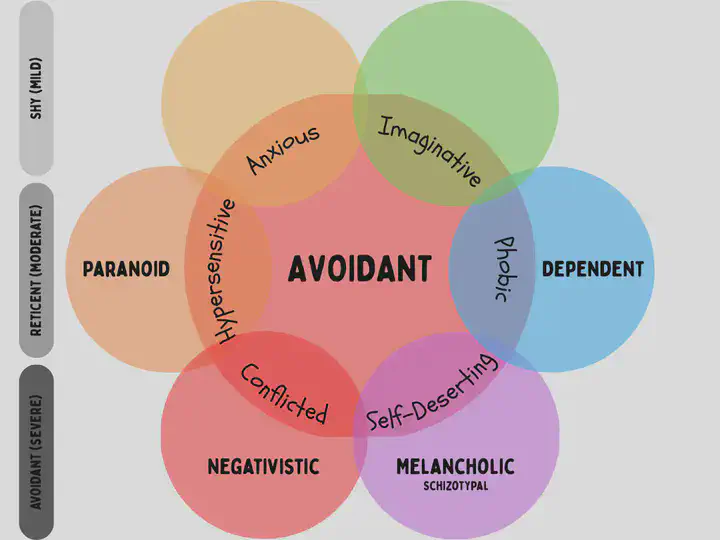
Avoidant personality disorder is one of the most recent personality disorders in the DSM, appearing with several others in the DSM-III in 1980 when schizoid personality disorder was separated into schizoid, avoidant, and schizotypal personality disorders. Notably, avoidant personality’s history is the shortest, only showing up in 1969 by Millon1 2. Millon had some interesting takes on this personality, so let’s see what he had to say about its subtypes.
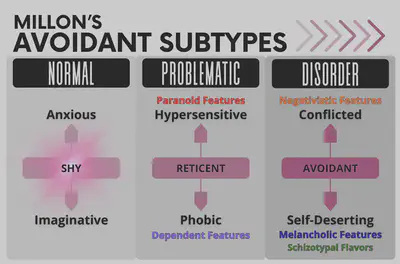
Shy Personality: Mild - Normal Level1 2
Millon categorized his personality subtypes by severity, with mild being more “healthy” and severe being more “unhealthy” or at a clinical/disordered level. At the mild level, individuals won’t likely show up for treatment, but they still struggle with low self-esteem, feeling uneasy in social situations, and hypersensitivity regarding (potential) criticism, rejection, and embarrassment. However, when they are in safe settings and feel socially secure, they can function well. So, let’s start with Millon’s less problematic (or dare I say more “normal”) subtypes of avoidant personality, which he simply labeled as Shy: The “Anxious” subtype and the “Imaginative” subtype.
Anxious1 2
The Anxiously Shy subtype tends to be sluggish, inefficient, passive, private, and sensitive to rejection, with feelings of inadequacy, low confidence, and self-devaluation. On the inside, they are tense and fearful, but can look gentle, calm, and put together on the outside. They can actually have a lot of difficulty finishing what they started because of self-criticism and fear of external negative evaluation. They reject and avoid their emotions, escaping into their head and mind to handle things through self-knowledge and self-revelation…but they usually can’t find that peace due to chronic pain and anguish about existence, reinforcing their withdrawal into the self. Socially, they are conflicted because they do want to be recognized and appreciated, but don’t want to be seen or the center of attention. Thus, they avoid social situations, especially conflict and confrontation. Given the right person, they might let their guard down and express themselves, but otherwise, they can fade into the background and disconnect from the world.
Imaginative1 2
The Imaginatively Shy subtype tends to be apathetic, distrustful of others, passive, self-sacrificing, and non-competitive with low self-esteem. They are socially hesitant and like to avoid social interaction, unless they can find a safer niche where there is stable security and social peace. They tend to believe that relationships are ingenuine and don’t last, so they depend only on the self and suppress their concern for other’s wellbeing. They don’t take initiative to have a better life, but they do fantasize about it! They hold their fantasies close, and in their fantasies, they can become fairly rigid, getting bogged down in rules, procedures, and moral correctness. They lack the energy to make any world changes that they think about, but they can control their environment, being meticulous and imposing structure. According to Millon, the Imaginatively Shy subtype doesn’t have a clear overlap with any other personalities. However, I personally see a flavor of schizoid with the tendency toward fantasy, daydreaming, and imagination as an escape from difficult reality, as well as an overlap with compulsive or phobic personalities with their anxious rigidity.
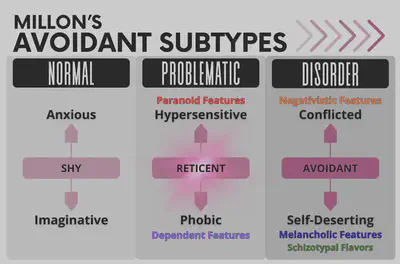
Reticent Personality: Moderate - Problematic Level1 2
Individuals at the mild level can slip into the moderate level due to isolation and fewer opportunities for personal growth. The moderate subtypes are at an abnormal level but not necessarily in clinically disordered territory. They can still function, but definitely run into hardships. It’s not yet avoidant personality disorder, so Millon named this level “Reticent,” and he highlighted two subtypes called “Hypersensitive” and “Phobic.”
Hypersensitive (Paranoid Features)1 2
The Hypersensitively Reticent subtype overlaps with paranoid features, being high strung, prickly, tense, bitter, suspicious, and hypervigilant to potential rejection or abuse. They have a superantennae that constantly scans their surroundings to pick up on where potential danger might be. They try to squish down their anger and suppress it, but it doesn’t work well. They can also be quite moody and unpredictable with rapidly shifting emotions due to pent up resentment. They expect rejection, but will have different feelings about it at different times…sometimes sadness, sometimes passivity, sometimes anger outbursts. This quote from Millon really stuck out to me. A hypersensitive reticent is apt to “make the molehill of a minor and passing slight into a mountain of personal ridicule and condemnation” (Millon, 2011, p. 731).
Phobic (Dependent Features)1 2
The Phobicly Reticent subtype overlaps with dependent features. They have persistent generalized anxiety that they cannot escape. They have an intense desire for closeness, but also deep distrust and fear of loss…though, they would never express their fear of loss, being scared to speak it into existence. Instead, they unconsciously displace and redirect their anxieties onto something more tolerable, tangible, and safer, called a “phobic object,” which allows them to avoid dealing directly with their actual fears. It gives a sense of control and is oftentimes symbolic. For example, instead of focusing on their fear of intimacy with a romantic partner, they fear the intrusive dog next door that comes into their yard; or instead of facing their fear of being close to others in a confined space, they are scared of elevators. Unsurprisingly, they are also prone to social phobia because they fear rejection and humiliation.
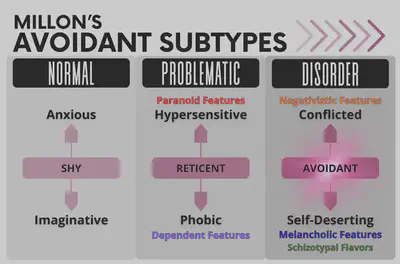
Avoidant Personality: Severe - Disorder Level1 2
The severe level is where the actual DSM avoidant personality disorder shows up. Millon parses this level out following more active and passive presentations. They fear humiliation and rejection so much that they intentionally isolate and disengage to protect themselves and tend to their wounds. Millon differentiates between “Conflicted” Avoidants and “Self-Deserting” Avoidants.
Conflicted (Negativistic Features)1 2
The Conflicted Avoidant subtype is a more active presentation that showcases negativistic features, being grumpy, moody, anxious, and dysphoric, as well as feeling misunderstood, not appreciated, and demeaned. There is an intense conflict between wanting to be detached and being fearful of independence. They want attachment, closeness, acceptance, and affection, but foresee a ton of disappointment and pain, which is paired with very low self-esteem. If they try to be independent, they fear failure that would lead to humiliation; but if they have to rely on others, there is very deep resentment and sometimes lashing out. They attempt to suppress their anger, but it leads to impulsive hostility. Then they feel humiliated for their outbursts, resulting in withdrawal. So, the conflict remains: They can’t act alone because of self-doubt, but can’t rely on others because of mistrust. Sometimes when they’re not stressed, they are in denial of previous resentments and present the self as well, but this false veneer cracks easily under pressure.
Self-Deserting (Melancholic and Schizotypal Features)1 2
The Self-Deserting Avoidant subtype is a more passive presentation that overlaps with melancholic and schizotypal features. They withdraw into the self to avoid any discomfort regarding relating to others. They usually start with fantasy coping skills, but find that fantasy isn’t enough…it just highlights their misery, pain, and anguish. So they succeed in avoiding social exposure and humiliation, but can’t escape their inner torment (melancholic). They can’t turn to others and are socially aversive, but there’s also high self-devaluation - merging avoidant and depressive/melancholic personalities. They end up trying to release themself from their self-conscious awareness, which results in them abandoning the self completely. They neglect their wellbeing and have trouble with even the littlest self-care. Some may even head toward suicide, and some head toward emotional numbness. Sometimes, the avoidance of cognitive self-awareness might lead to a splitting of consciousness, which is a schizotypal merging- where reality and the self starts to fall apart, fragment, and be disorganized.

Do you resonate with any of these? Comment on YouTube or contact us here! Avoidant personality dynamics and disorder can be hard to parse out. If you want to dive into your own avoidance or the avoidant dynamics of someone in your life, therapy and/or psychological testing can help! If you’re in Virginia (or a PsyPact state), check out our private practice, Quest Psychological and Counseling Services for available services.
you’re a provider stuck on a case, we also offer consultations for mental health professionals!
References
-
Millon, T., Grossman, S., Millon, C., Meagher, S., & Ramnath, R. (Eds.). (2004). The schizoid personality. In Personality disorders in modern life (2nd ed., pp. 371–402). Wiley. ↩︎ ↩︎ ↩︎ ↩︎ ↩︎ ↩︎ ↩︎ ↩︎ ↩︎ ↩︎
-
Millon, T. (2011). Apathetic styles, asocial types, schizoid disorders: The AAS spectrum. In Disorders of personality: Introducing a DSM/ICD spectrum from normal to abnormal (3rd ed., pp. 663–707). Wiley. https://doi.org/10.1002/9781118099254 ↩︎ ↩︎ ↩︎ ↩︎ ↩︎ ↩︎ ↩︎ ↩︎ ↩︎ ↩︎

Doc Fish
Licensed Clinical Psychologist
I am a licensed clinical psychologist who specializes in personality, attachment, and psychodynamic treatment.