Antisocial Personality vs. Psychopathy


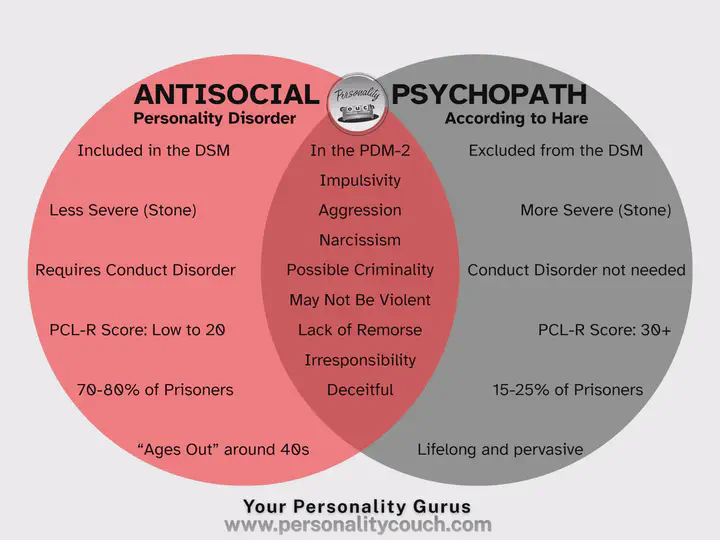
Today, the word “psychopath” elicits a picture of a cruel, law-breaking, destructive individual who is probably a murderer. This is actually nowhere near what the original understanding of the term meant. In the 1800s, it was a question of etiology: Does the pathology originate in the psyche (psychopath), or does society create the pathology (sociopath)1. Psychopathy captured a vast array of disorders, until Cleckley’s 1941 book, “The Mask of Sanity,” attempted to clear up some of the terminology confusion1 2 …but the confusion has continued.
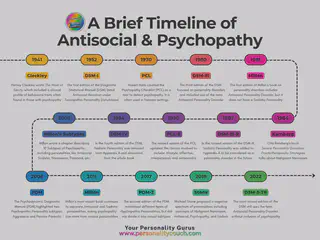
A Broad Timeline of Psychopathy in Different Theories
The first DSM in 19523 did not use the term psychopathic, instead listing sociopathic personality disturbance until the 1980 publication of the DSM-III used the term antisocial personality disorder4.
Meanwhile, psychodynamic literature and the PDM-25 stated,
“We prefer the earlier term ‘psychopathic’ (Cleckley, 1941; Hare, 1991; Meloy, 1988, 1997) to the current ‘antisocial.’ Many people with psychopathic personalities are not obviously antisocial; that is, they are not observably at odds with social norms.
In fact, many people with psychopathic personalities are able to pursue their agendas in contexts of social approval and even admiration” (p. 50)5.
Robert Hare6 used Cleckley’s2 work to create a Psychopathy Checklist in the 1970s, narrowing the definition of a psychopath1.
The DSM seemingly attempted to capture a more severe personality pathology, listing sadistic personality in the appendix of the DSM-III-R (1987), but it was dropped in the DSM-IV (1994), with the current DSM only listing antisocial personality disorder7 4 8.
However, the PDM-28 and Millon4 8 both describe a separate sadistic personality5 4 8… and finally Stone proposed a negative personality continuum including antisocial, psychopathy, and sadism9 10.
Let’s unpack this more!
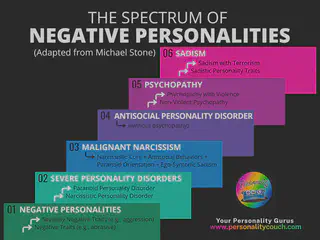
Stone’s Negative Spectrum of Personality 9 10
Michael Stone, a forensic psychiatrist, wrote about a negative spectrum of personality with six main components where he argued psychopathy is more severe than antisocial. Each level is progressively worse and subsumes all that comes before it. See Episode 27: What’s Worse Than a Narcissist? The Baddest of Them All and its corresponding blog for more in depth information.
- Negative personalities with negative traits like being abrasive or severely negative traits like aggression.
- Severe personality disorders including narcissistic and/or paranoid personality disorders.
- Malignant narcissism11 is narcissism with antisocial behavior, sadism/aggression, and paranoid flavors.
- Antisocial personality disorder (without psychopathy).
- Psychopathy, including non-violent psychopathy or psychopathy with violence.
- Sadism, including sadistic personality traits, as well as sadism with terrorism.
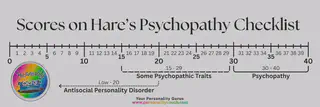
Hare’s Psychopathy Checklist 6
Robert Hare, a forensic psychologist, expanded Cleckley’s2 work and created the Hare Psychopathy Checklist in the 1970s, and it has since been revised: Hare Psychopathy Checklist Revised (PCL-R)6. The PCL-R is a 20-item semi-structured interview where one can obtain a score ranging from 0 to 405. Stone highlighted those with only antisocial personality disorder would have a PCL-R score of “low to about 20”9. Scores from 15 to 29 indicate “some psychopathic traits,” and scores of 30+ reflect clear-cut psychopathy9.
This is super important to understand because it contributes to the differentiation of antisocial personality disorder and psychopathy, as psychopathy has a much narrower definition. This is demonstrated by 70-80% of prisoners meeting criteria for antisocial personality disorder, but only 15-25% meet the criteria for psychopathy according to the PCL-R9 10. Another big difference is that antisocial children don’t usually become antisocial adults, and young adults with antisocial personality disorder will “burn out” around their 40s, whereas psychopathy is pervasive. The aging out dynamic does not happen in psychopathy9 12 10.
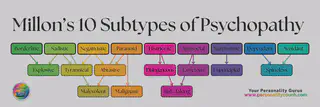
Millon’s 10 Psychopathic Subtypes 13
While Hare created a measure to detect the severity of psychopathic dynamics, Millon focused on understanding the different personalities, features, and flavors that can make up a psychopath. He wrote a chapter outlining 10 Subtypes of Psychopathy with many of them overlapping with Stone’s continuum. A very brief overview is listed below:
- Spineless Psychopath (Avoidant, Dependent): Insecure and feel weak, harming others as a countermove.
- Unprincipled Psychopath (Narcissistic): Arrogant, fraudulent, and exploitative.
- Disingenuous Psychopath (Histrionic): Impulsive, resentful, and deceitful, wrapped up in a friendly, sociable exterior.
- Risk-Taking Psychopath (Histrionic, Antisocial): Flagrantly disregard danger and pursue thrill at the expense of others, being irresponsible and neglectful.
- Covetous Psychopath (Antisocial): Feels like life ripped them off, so they revengefully take from others to make up for it.
- Malignant Psychopath (Paranoid): Resentful, mistrustful, envious, and vindictive, thinking others are out to get them and having vengeful fantasies that can be acted out.
- Abrasive Psychopath (Paranoid, Negativistic): Obnoxious and antagonistic, spewing venom without remorse.
- Explosive Psychopath (Sadistic at borderline level): Has unpredictable, vindictive, and rageful outbursts with or without provocation, though they are super sensitive to feelings of betrayal.
- Malevolent Psychopath (Paranoid, Sadistic): Suspicious, hostile, vindictive, and destructive, as well as having a cold-blooded ruthlessness to find revenge for their childhood mistreatments. “Many murderers and serial killers fit this” (p. 168)13.
- Tyrannical Psychopath (Negativistic, Sadistic): Abusive, calculating, and actively attacking when met with resistance/weakness, going out of their way to be inhumane and unmerciful. They are one of the most pure forms of the classical psychopath.

Overall, it seems that Millon4 8 13 understands the types and flavors of psychopathic personalities, Hare6 understands the dynamics that highlight severity to indicate a psychopath, and Stone10 understands there’s a continuum of building blocks that creates a pathway from non-pathological personalities to psychopathy. All are important in comprehending the big picture of how antisocial personality overlaps with, and is different from, psychopathy.
Let us know your thoughts on the differences between antisocial personality and psychopathy! If you want to better understand these dynamics in yourself or others, therapy and/or psychological testing can help. If you’re in Virginia (or a PsyPact state), check out our private practice, Quest Psychological and Counseling Services for available services. If you’re a provider stuck on a case, we also offer consultations for mental health professionals!
References
Akhtar, S. (1992). Broken structures: Severe personality disorders and their treatment. Jason Aronson, Inc. ↩︎ ↩︎ ↩︎
Cleckley, H. (1988). The mask of sanity: An attempt to clarify some issues about the so-called psychopathic personality (5th ed.). Emily S. Cleckley. ↩︎ ↩︎ ↩︎
American Psychiatric Association. (1952). Diagnostic and statistical manual: Mental disorders (1st ed.). https://www.turkpsikiyatri.org/arsiv/dsm-1952.pdf ↩︎
Millon, T. (1981). Disorders of personality: DSM-III, Axis II (1st ed.). Wiley. ↩︎ ↩︎ ↩︎ ↩︎ ↩︎
Lingiardi, V., & McWilliams, N. (Eds.). (2017). Psychodynamic diagnostic manual: PDM-2 (2nd ed.). The Guilford Press. ↩︎ ↩︎ ↩︎
Hare, R. D., Harpur, T. J., Hakstian, A. R., Forth, A. E., Hart, S. D., & Newman, J. P. (1990). The revised Psychopathy Checklist: Reliability and factor structure. Psychological Assessment: A Journal of Consulting and Clinical Psychology, 2(3), 338-341. https://doi.org/10.1037/1040-3590.2.3.338 ↩︎ ↩︎ ↩︎ ↩︎
American Psychiatric Association. (2022). Diagnostic and statistical manual of mental disorders: DSM-5-TR (5th edition, text revision.). https://doi.org/10.1176/appi.books.9780890425787 ↩︎
Millon, T. (2011). Disorders of personality: Introducing a DSM / ICD spectrum from normal to abnormal (3rd edition). John Wiley & Sons, Inc. ↩︎ ↩︎ ↩︎ ↩︎
Itzkowitz, S., & Howell, E. F. (Eds.). (2019). Psychoanalysts, psychologists and psychiatrists discuss psychopathy and human evil. Routledge. https://doi.org/10.4324/9780429262425 ↩︎ ↩︎ ↩︎ ↩︎ ↩︎ ↩︎
Stone, M. H. (2018). The place of psychopathy along the spectrum of negative personality types. Contemporary Psychoanalysis, 54(1), 161–182. https://doi.org/10.1080/00107530.2017.1420376 ↩︎ ↩︎ ↩︎ ↩︎ ↩︎
Kernberg, O. F. (1984). Severe personality disorders: Psychotherapeutic strategies. Yale University Press. ↩︎
Stone, M. H. (2007). Violent crimes and their relationship to personality disorders. Personality and Mental Health, 1(2), 138–153. https://doi.org/10.1002/pmh.18 ↩︎
Millon, T., Simonsen, E., Birket-Smith, M., & Davis, R. D. (Eds.). (2003). Psychopathy: Antisocial, criminal, and violent behavior. Guilford Press. ↩︎ ↩︎ ↩︎
