Antisocial Personality Subtypes (Millon)


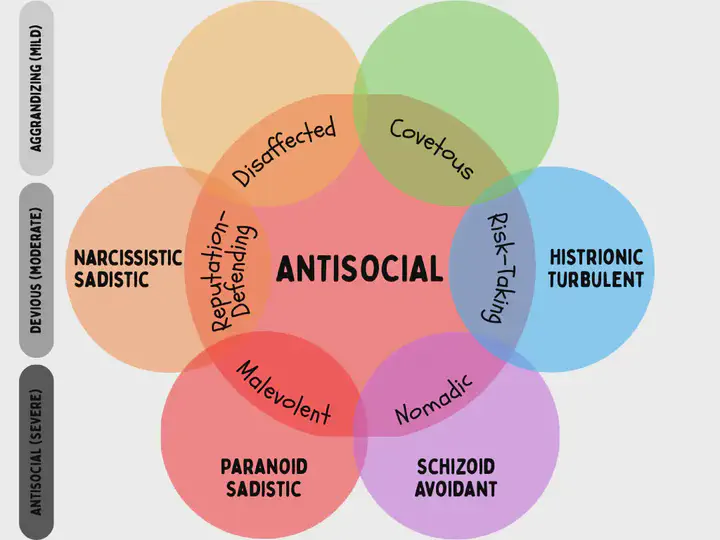
Antisocial personality disorder has an interesting history filled with confusion and arguments, one of the first being the difference between psychopathic and sociopathic1 2. Are antisocials born (psychopathic) or made (sociopathic)? While psychodynamic researchers did note there is an aggressive antisocial personality (impulsive, acting out) and a passive-parasitic personality (con-artist, chameleon)2, there aren’t many subtypes outside of Millon’s work1 2. So let’s take a look!
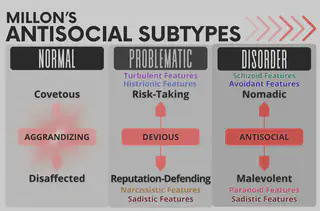
Aggrandizing Personality: Mild - Normal Level1 2
At the mild level, we have the Aggrandizing (“to make bigger”) Personality. Even though this is the mild level, society often rejects these antisocials who go against the current, viewing them as pathological. However, the “bad things” about antisocials can be sublimated into society in a way that is adaptive. Things like: ambition, independence, competition, risk-taking, decisiveness, etc can work for society and for themselves. Their willpower is amazing, and they’re great at overcoming things, but do so independently. They take charge, they’re assertive, and they’re dominant… and they can also be overly focused on self-interest. Let’s look at the covetously aggrandizing and disaffected aggrandizing subtypes.
Covetously Aggrandizing 1 2
The core of the covetously aggrandizing subtype involves greedy self-enhancement and a desire to possess/dominate by being pushy, envious, and taking over things. They are angry, resentful, and revenge driven, “manipulating others like pawns in a power game.” Why? Because they feel like life has deprived them of what they are rightfully owed (love, support, materials), while others have more than enough. So, they take, even if it means lying or destroying, but they are insatiable, like a self-centered lion who is forever hungry - a predator pursuing prey. They can even be ostentatious and display what they’ve taken as a form of power. It’s important to note that this is different from narcissists who have a passive attitude of entitlement and can feel satisfied with possessions when it meets their image needs. Covetous aggrandizing personalities are actively exploitative to take things because of their deep sense of emptiness and powerful hunger for love and stuff they didn’t get in childhood.

Disaffected Aggrandizing 1 2
The disaffected aggrandizing subtype is oppositional, not caring to please others, rely on others, or consider others’ input when making decisions. They focus on their autonomy because they don’t want to conform to society or play by the rules. They have so much energy and try to direct it, but they can take on too much too fast or start something very intensely, failing to follow through. They struggle with abstract goals, preferring to work physically for visual, tangible outcomes… and those outcomes need to happen ASAP because they are quite impatient. They switch between a troubled discontentment and unstable, random action, especially because they like the unconventional ideas that are hard to achieve. They are motivated by newness and risk, so sometimes others view them as making impulsive moves, but they actually have thought it out. Their disillusionment with self and others, paired with their dissatisfaction, results in withdrawal, irritability, and hostility alongside their courageous self-determination.
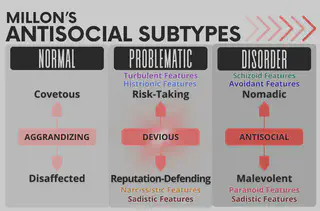
Devious Personality: Moderate - Problematic Level 1 2
Mild subtypes can disintegrate into moderate severity if their high needs for gratification and independence are not successfully met, becoming more impulsive, irresponsible, and non-conforming. They become more overtly antisocial and devious. Millon describes the risk-taking devious and the reputation-defending devious.
Risk-Taking Devious (Histrionic, Turbulent (Exuberant) Features) 1 2
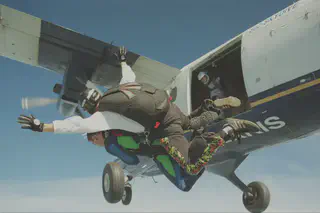
The Risk-Taking Devious subtype overlaps with histrionic and turbulent features, being impulsive, unreflective, fearless, audacious, and reckless. They seek thrills, needing excitement and stimulation, totally unfazed by danger, pursuing legit perilous adventures and gambling with life in search of trying to feel alive. Their sympathetic nervous system needs a much higher input to achieve an excitement level. They do things like skydiving, drag racing, and jumping into a pool from a hotel balcony, but to others, it seems silly, not courageous. They don’t control their behaviors, act before thinking, and don’t think or care about consequences. There’s a case in Millon’s book2 where a man “has a death wish he tries to sell as a quest for the ultimate life” (Millon 2011, p. 451). So even at events with others doing similar things, he’d get kicked out for being too extreme. He reportedly stated, “You have to have a hint of death in your life for existence to be truly savory” (Millon 2011, p. 451).
Reputation-Defending Devious (Narcissistic, Sadistic Features) 1 2
The Reputation-Defending Devious subtype overlaps with narcissistic and sadistic features, wanting status and reputation. They become someone “not to be trifled with,” wanting others to see them as infallible, powerful, brave, invincible, not to be conquered, always to be respected, etc. They are overreactive to slights, sometimes brooding then having an outburst, or sometimes erupting intensely, being intimidating, threatening, and posturing. Their focus is on defending their reputation, but not necessarily in hostility. Some are loners, others in gangs. Some are aggressive leaders, alphas, and dominants at the ‘top of the pack.’ Sometimes they can be violent which is the sadistic part. They can engage in violence/terrorism, feeling like they are the victim and are justified in their counteractions.
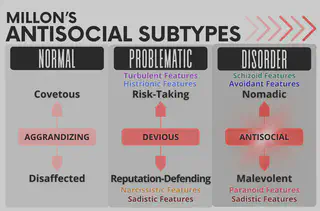
Antisocial Personality: Severe - Disorder Level 1 2
The moderate subtypes can disintegrate easily into the severe level due to social rejection, which means we’re possibly in Antisocial Personality Disorder territory where they withdraw or turn aggressive toward society, focused only on their own self-interest. Their previously antisocial and socially unacceptable acting out turns into a pervasive lifestyle. Here, we have the nomadic antisocial and the malevolent antisocial.
Nomadic Antisocial (Schizoid, Avoidant Features) 1 2
The Nomadic Antisocial subtype showcases schizoid and avoidant features. They still have deep anger, resentment, and desire for pleasure that stem from previous rejection and injustices, but they are less active in their revenge-seeking, preferring to detach themselves from the social world and societal responsibilities. Why? Because they are defending against feeling abandoned, ostracized, and ill-fated, having a core mood involving doom and invincibility. They prefer to focus only on basic survival, roaming, wandering, drifting, sometimes being homeless, and functioning on the outskirts of society. I like this quote from Millon: “This sense of ‘being no place’ is both similar to and different from the experience of depersonalization; nomadics appear vaguely disconnected from reality, possess no clear sense of self, and seem to be transients both within themselves and their environments” (Millon 2011, p. 458). Additionally, if provoked or using substances, they can impulsively act out, and they can be prone to predation, prostitution, and alcoholism.

Malevolent Antisocial (Sadistic, Paranoid Features) 1 2
The Malevolent Antisocial subtype showcases sadistic and paranoid features being vicious, brutal, callous, fearless, and hostile with a chip-on-the-shoulder attitude and a readiness to lash out at all times. Motivated by the unjustness of their childhood mistreatments (real or perceived), they are guarded against constant potential imminent attacks and betrayals, distrusting any positivity from others. They have adopted a “cold-blooded ruthlessness" in their pursuit for revenge and retribution, rejecting their own weakness and proving their own strength in a way that can be dangerous or elicit punishment…which makes them feel they are treated unjustly…which turns into a cycle. With more power, they actually become more brutal to keep supporting their strong, powerful self-image.

Do you resonate with any of these? Antisocial personality dynamics and disorder can be extremely difficult to separate from other dysfunction. If you want to dive into your own antisocial side or the antisocial dynamics of someone in your life, therapy and/or psychological testing can help! If you’re in Virginia (or a PsyPact state), check out our private practice, Quest Psychological and Counseling Services for available services. If you’re a provider stuck on a case, we also offer consultations for mental health professionals!
References
Millon, T., Grossman, S., Millon, C., Meagher, S., & Ramnath, R. (Eds.). (2004). The schizoid personality. In Personality disorders in modern life (2nd ed., pp. 371–402). Wiley. ↩︎ ↩︎ ↩︎ ↩︎ ↩︎ ↩︎ ↩︎ ↩︎ ↩︎ ↩︎ ↩︎
Millon, T. (2011). Apathetic styles, asocial types, schizoid disorders: The AAS spectrum. In Disorders of personality: Introducing a DSM/ICD spectrum from normal to abnormal (3rd ed., pp. 663–707). Wiley. https://doi.org/10.1002/9781118099254 ↩︎ ↩︎ ↩︎ ↩︎ ↩︎ ↩︎ ↩︎ ↩︎ ↩︎ ↩︎ ↩︎ ↩︎ ↩︎
