Antisocial Personality Disorder - The DSM’s Perspective…and Mine
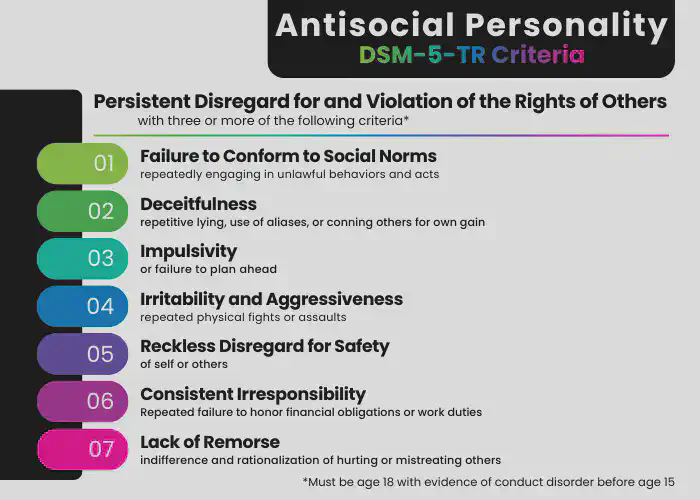
Antisocial personality disorder was in the first edition of the DSM in 1952 under the term “Antisocial Reaction,” which is part of the “Sociopathic Personality Disturbance” category1. It involved people who were callous, hedonistic, irresponsible, emotionally immature, and loyal to no one, always getting into trouble and not learning from consequences due to rationalizing their behaviors1. The most recent (2022) criteria of antisocial personality disorder can be found in the DSM-5-TR (Diagnostic and Statistical Manual of Mental Disorders, Fifth Edition, Text Revision2). It provides a more nuanced and narrow view of this personality, but focuses more on behaviors rather than the internal workings of this personality. In my opinion, I feel this has led to gross misunderstandings related to antisocial personalities. Let’s look at the DSM portrayal and see what you think!

| Note: Text in these boxes are the exact words from DSM-5-TR2 |
|---|
Antisocial Personality Disorder Criteria
| “A pervasive pattern of disregard for and violation of the rights of others, occurring since age 15 years, as indicated by three (or more) of the following2:” (p. 749) |
|---|
The DSM-5-TR’s framework for all personality disorders involves a pervasive pattern that shows up in many parts of life in multiple settings (e.g. home, school, work). Antisocial personality disorder is special in that it defines an actual age, 15 years old, that symptoms must occur by. So it’s not just something that pops up in middle age - it’s a long-standing pattern that starts in childhood and/or adolescence. The main pattern is not caring about and infringing upon the rights of others, demonstrated by three or more of the following noted in the boxes below.
| “Failure to conform to social norms with respect to lawful behaviors, as indicated by repeatedly performing acts that are grounds for arrest2.” (p. 749) |
|---|
Whether or not they’re actually caught or arrested, they repeatedly do things they could be arrested for such as, stealing, harassment, destruction of property, or doing illegal things at work. They may be aware of the desires, rights, or emotions of others, but they don’t care. They can lack empathy and take an “everyone has to be out for themselves” approach to life, being extremely self-focused.

| “Deceitfulness, as indicated by repeated lying, use of aliases, or conning others for personal profit or pleasure2.” (p. 749) |
|---|
Antisocials use whatever they need to for their own gain. Lying is something they use often, to cover up their last offense, and the one before that, and the one before that…it spins into their own version of rationalized “reality.” There’s a long history in psychology about the “passive/parasitic” antisocial personality that is a con artist, setting up Ponzi Schemes3 4. They are no stranger to manipulation, conniving, and malingering to get out of responsibilities (e.g., work, child support, criminal charges) or gain something they desire (e.g., sex, power, money). Some can be super charming and impressive with their communication and intellect, but it’s superficial. It’s all to get what they want.
| “Impulsivity or failure to plan ahead2.” (p. 749) |
|---|
Antisocial persons often make spur-of-the-moment decisions, resulting in spontaneous changes in areas like work, home life, or social relationships. They may never have kept a monogamous relationship, instead having a ton of intimate partners. Not only that, but they can be exploitative and irresponsible with those partners. Or they might think their boss is stupid after a specific interaction, so they just don’t show up and quit. Or it can simply be because a rule is “dumb,” and they don’t believe rules apply to them anyway. It doesn’t have to be a major thing that triggers the impulsivity. Again, it can be for gain or to avoid negative consequences. The DSM notes they might be arrogant and have an inflated ego, perhaps feeling like they are too superior for ordinary work, or perhaps they are just super cocky, opinionated, and self-assured. They also tend to not have realistic concerns about problems that could affect them, either now or in the future.

| “Irritability and aggressiveness, as indicated by repeated physical fights or assaults2.” (p. 749) |
|---|
The DSM specifically notes that this does include beating a spouse or child. It could also involve animal cruelty and public brawls. It could be basically anything that’s taking their anger out on others and disregarding other living things. There’s a superiority to it, as others are viewed as beneath them. However, it is important to note that self-defense, or defending others, in an aggressive manner is not something that fits here.
| “Reckless disregard for safety of self or others2.” (p. 749) |
|---|
There is a lot of risk taking and recklessness. It could show up in driving, so speeding all the time, driving under the influence, lots of accidents. It could be in sexual risk taking or risky substance use. It may even be putting a child in danger through neglect or failure to care. The DSM actually notes they can be reckless and irresponsible parents. Sometimes evidenced by malnutrition, illness from lack of hygiene, neighbors or community taking care of the food/shelter for the child, leaving the child without a caretaker when too young, or not using money for necessities but spending it irresponsibly. There’s a real disregard for the social world, other people, laws, rules, order, etc.

| “Consistent irresponsibility, as indicated by repeated failure to sustain consistent work behavior or honor financial obligations2.” (p. 749) |
|---|
Antisocials can be extremely irresponsible. They might be unemployed for long periods of time even though they could get a job, or just quit jobs without a plan to get another. They might just not show up for periods of time at work without any regard for the consequences affecting others. Financially, they might fail to support dependents or pay child support or default on debts. When it gets bad, they might fail to support themselves, fall into poverty or homelessness, become dishonorably discharged if in the military, or end up in penal institutions for years.
| “Lack of remorse, as indicated by being indifferent to or rationalizing having hurt, mistreated, or stolen from another2.” (p. 749) |
|---|
Lack of remorse in an antisocial person can look like displacing blame, minimizing/ignoring their harm, not compensating for harm they commit, and/or spinning a whole different story to keep blame off of themselves. They might think life is unfair, and that everyone is out to help themselves, so you “gotta do what ya gotta do” to survive and not be pushed around. They tend to blame victims for being weak, helpless, stupid, and deserving of whatever bad thing happened - a “he had it coming anyway” or “losers deserve to lose” mentality. The DSM literally says they “frequently lack empathy and tend to be callous, cynical, and contemptuous of the feelings, rights, and sufferings of others.” They really don’t care about people or about rules. There is an extreme self-focus.

There are some other interesting things the DSM says about antisocial personality disorder. Those with antisocial personality disorder “are more likely than individuals in the general population to die prematurely from natural causes and suicide.” Also, antisocials seem to age out of their behavior, often by 40 years old2,5. Which brings me to the question: Is the DSM describing behavior or an actual personality here? All of these criteria involve external, observable features, but none of the internal processes involved in the personality.
So, next we’ll have to explore other theories and conceptualizations to figure out what is going on beneath the surface of antisocial personalities! If you want to better understand an antisocial individual in your life, or if you are an antisocial personality and want to explore it, feel free to reach out! If you’re in Virginia (or a PsyPact state), check out our private practice, Quest Psychological and Counseling Services for available services. If you’re a provider stuck on a case, we also offer consultations for mental health professionals!
References
-
American Psychiatric Association. (152). Diagnostic and statistical manual: Mental disorders (1st ed.). https://www.turkpsikiyatri.org/arsiv/dsm-1952.pdf ↩︎ ↩︎
-
American Psychiatric Association. (2022). Diagnostic and statistical manual of mental disorders: DSM-5-TR (5th edition, text revision.). https://doi.org/10.1176/appi.books.9780890425787 ↩︎ ↩︎ ↩︎ ↩︎ ↩︎ ↩︎ ↩︎ ↩︎ ↩︎
-
Lingiardi, V., & McWilliams, N. (Eds.). (2017). Psychodynamic diagnostic manual: PDM-2 (2nd ed.). The Guilford Press. ↩︎
-
Millon, T. (2011). Disorders of personality: Introducing a DSM / ICD spectrum from normal to abnormal (3rd edition). John Wiley & Sons, Inc. ↩︎

Doc Fish
Licensed Clinical Psychologist
I am a licensed clinical psychologist who specializes in personality, attachment, and psychodynamic treatment.