The Schizoid & Histrionic Romance


Do opposites really attract? Like most questions in psychology, a simple ‘yes’ or ‘no’ does not suffice…the answer is: ‘it depends.’ While there are many ways these individuals contrast, I’m going to analyze the attraction between the detached, independent, introverted schizoid personality and the bright, dramatizing, and extraverted histrionic personality1.
Nancy McWilliams has a wonderful quote about this:
“Perhaps predictably, since human beings are often drawn to those with opposite and envied strengths, schizoid people tend to attract (and to be attracted to) warm, expressive, sociable people such as those with hysterical personalities” (McWilliams, 2011, p. 2054).
For more information on schizoid personality, see Schizoid Personality Disorder. To better understand the histrionic personality, see Histrionic Personality Disorder.
Schizoid-Histrionic Opposites & Overlaps
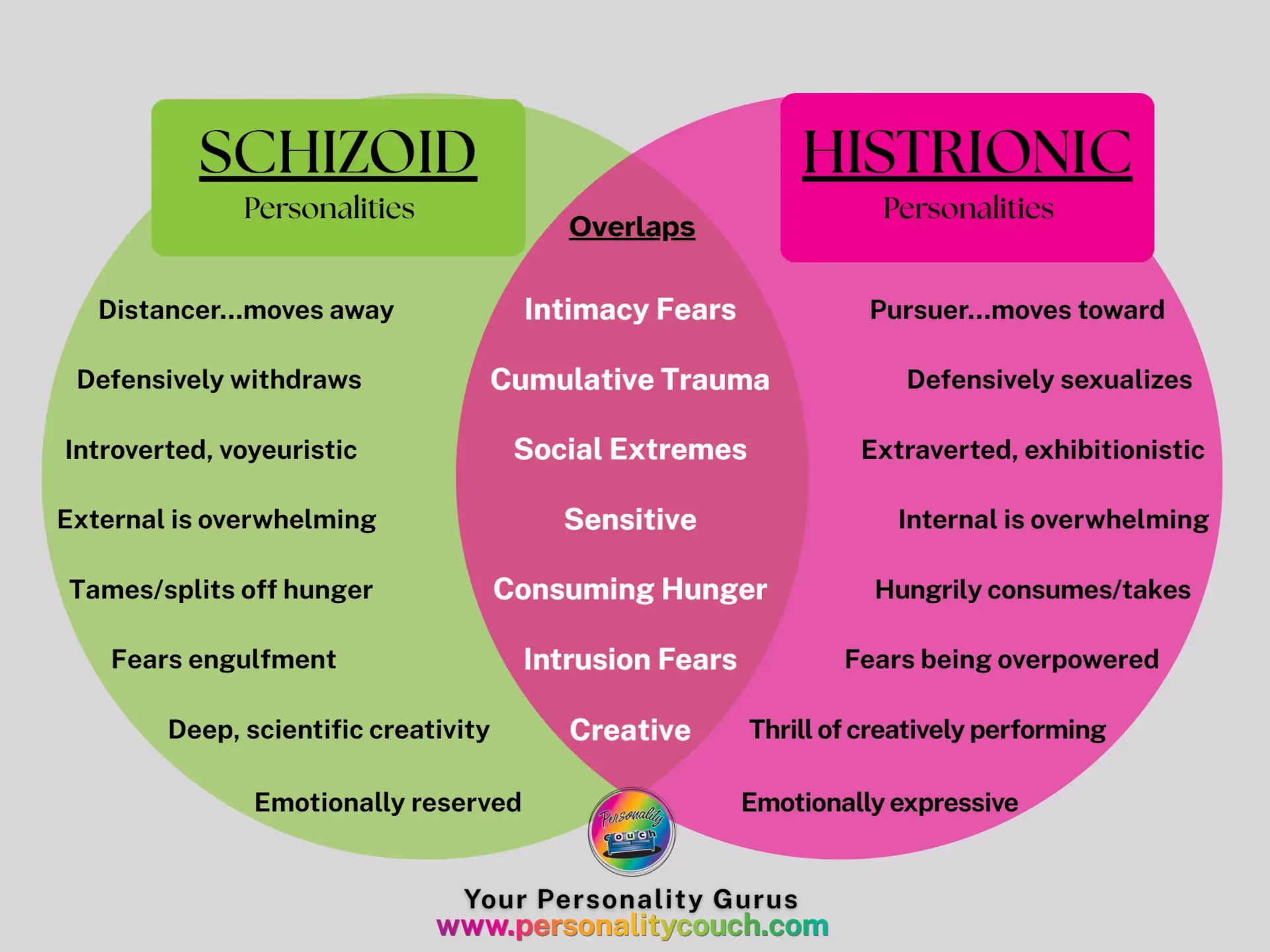
One of the main ways that schizoids and histrionics are opposite involves their interpersonal movement and dynamics. Schizoids are introverts, loving distance, moving away from others and watching from afar; while histrionics are extraverts, loving closeness, moving toward others, and seeking attention2 3 1. This can create a distancer-pursuer pattern where the schizoid backs away from the histrionic chasing them…(think Elsa from Frozen hiding/withdrawing while sister Ana seeks connection). Basically, schizoids and histrionics can drive each other crazy3. But they can also have a deep understanding of each other due to some overlapping experiences3.
Both schizoid and histrionic personalities tend to have cumulative traumatic experiences that build up, but aren’t necessarily big, isolated traumatic events (though, that can occur too, of course)1. They have repetitive microtraumas that lead to protective, defensive dynamics so that they can navigate a world that they’ve experienced as unsafe3 1. In childhood, they both tend to view their opposite sex parent as powerful and intrusive3. For example, the histrionic girl sees her dad as powerful (and fears him at the same time) and the schizoid boy watches his mom have power (and makes sure to try to keep his distance if she tries to engulf him).
Both schizoid and histrionic personalities feel a consuming sense of hunger3 BUT…schizoids handle it wayyy differently. The schizoid detaches from hunger and their own need for nourishment, believing love and dependency are dangerous2 3 1. In other words, schizoids can repress the normal desire to be loved and thus feel indifferent about connection with others1. Meanwhile, histrionics embrace their hunger and actively demand nourishment2 3 1. They voraciously consume care and love and attention, always needing more1.
Both schizoid and histrionic personalities are extremely sensitive…in very different ways2 3 1. The schizoid is easily overwhelmed by external stimuli, contrasting the histrionic’s tendency to be easily overwhelmed by internal stimuli2 3 1. For example, the schizoid does not necessarily enjoy intense sensory input or others imposing upon their space, resources, and time, but they do enjoy sitting with themselves and exploring their innermost thoughts. Oppositely, histrionics avoid their internal emotions and experiences, preferring to be center stage with the bright lights and an intense external environment. In this way especially, schizoids and histrionics are each other’s inverse.
Attraction & Dynamics
Both of these personalities have somewhat extreme features that can make them misfits in the social world, yet because they are still human (even if they feel as if they are not #schizoid🤖), they have intimacy needs3 1. They want to be known, seen, and to share life with someone, no matter if those needs are split off or exaggerated to avoid true emotional intimacy. (Schizoids may be so detached from this that they may be annoyed by the previous sentence and feel misunderstood; and histrionics may reject it as well, preferring to repress negative emotions). Regardless, histrionics and schizoids can un/subconsciously recognize and respect this in each other, especially finding safety when neither party is intrusive3.
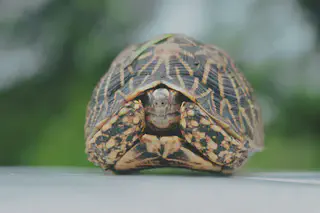
If we think about schizoids as turtles🐢, using their shell to protect against an impinging world, the histrionic’s sunny, warm presence☀️ can entice them to come out of their shell, if they feel safe, of course. Schizoids can also feel more comfortable with a histrionic demonstrating how to express, socialize, and emote…or just having the histrionic do it for them😂. They can lessen a schizoid’s social-emotional burden and live vicariously through the histrionic. Meanwhile, the histrionic admires the schizoid’s confidence to be anchored in their beliefs, values, truths, and emotions. A silly visual comes to mind of a turtle sunning itself on a rock with a string wrapped around itself connected to a beautiful butterfly fluttering in the sky 🪨🐢🪁🦋🌪️. The turtle is fascinated by the idea of flying - of fully existing, while the butterfly finds safety in knowing the wind or a storm won’t blow them away from their beloved turtle-y attachment.

Schizoid-Histrionic Dynamics Described with Crayons
If humans were boxes of crayons, we all originally come fully stocked with access to all the colors, but throughout life, we learn to use our colors differently. Most personalities end up learning to use only certain colors, then deny, project, or hide other colors…except schizoids. Schizoids just keep all their colors inside and make their box boring and grey to avoid attention and protect themselves against intrusion🩶😶🌫️. Meanwhile, the histrionic uses all their colors to beautify their box, somehow obtaining glue and glitter to exude brightness and gain attention🌈✨. All colors are used, but the darker colors are saved only for shorter depressive times that occur in between frantic creative explosions! 💥In this dynamic, the schizoid is fascinated by the histrionic’s use of all the colors, finding it authentic and deep, though intense. The histrionic sees the schizoid’s boring box and finds purpose in spreading their colors to it.
In a healthy dynamic, the schizoid gets some nice simplistic pops of color on their box that they genuinely enjoy, while they also get to keep their box closed because everyone is still paying attention to the glittery histrionic box. And the histrionic box is enjoying life, knowing the schizoid box is watching them and can keep them anchored because they understand all the colors.
If the dynamic is more pathological, the histrionic box can chase the schizoid box with rocket launchers🚀 filled with colors and glitter bombs while the schizoid runs for the bunker they built with the 64 locks🔒 that will keep them safe…and you’ll never see them again. #distancer-pursuer
There’s a short story McWilliams3 references about the schizoid-histrionic dynamics called The Illusionless Man & the Visionary Maid by Allen Wheelis that describes:
- For the schizoid man, “…she nevertheless stirred him…brought him no comfort; but, holding her, he felt life, and would not give it up.” 🧬🪷
- For the histrionic woman, “he was a rock and she leaned on him.” 🪨⚓
I think that’s a good summary of the schizoid-histrionic romance and interpersonal dynamics: The histrionic brings life to the schizoid’s struggle with non-existence, and the schizoid brings an anchor point to the histrionic’s frazzled flights of living☯️.
I’ll end with this: A colleague of McWilliams’ proposed that, “Inside every schizoid individual is a hysterical one, and vice versa3.” If you’re interested in exploring the schizoid-histrionic dynamics, therapy and/or psychological testing can help! If you’re in Virginia (or a PsyPact state), check out Quest Psychological and Counseling Services for available services. If you’re a provider stuck on a case, we also offer consultations for mental health professionals!
References
McWilliams, N. (2011). Psychoanalytic diagnosis: Understanding personality structure in the clinical process (2nd ed.). Guilford Press. ↩︎ ↩︎ ↩︎ ↩︎ ↩︎ ↩︎ ↩︎ ↩︎ ↩︎ ↩︎ ↩︎
Lingiardi, V., & McWilliams, N. (Eds.). (2017). Psychodynamic diagnostic manual: PDM-2 (2nd ed.). The Guilford Press. ↩︎ ↩︎ ↩︎ ↩︎ ↩︎
McWilliams, N. (2006). Some thoughts about schizoid dynamics. Psychoanalytic Review, 93(1), 1-24. https://doi.org/10.1521/prev.2006.93.1.1 ↩︎ ↩︎ ↩︎ ↩︎ ↩︎ ↩︎ ↩︎ ↩︎ ↩︎ ↩︎ ↩︎ ↩︎ ↩︎ ↩︎
