Obsessive-Compulsive vs. Schizoid: What’s the Difference?


Obsessive Compulsive Personality Disorder (OCPD) doesn’t have many differential diagnoses1, BUT it can blend with basically every other personality disorder2, making it difficult to parse out at times. Interestingly, the literature notes there can be an overlap between obsessive-compulsive personality disorder and narcissistic personality disorder1 3, as they can both be perfectionistic; however, narcissists think they have achieved perfection (and superiority), while those with obsessive-compulsive personality disorder never feel like they have achieved perfection, instead being very self-critical1. Additionally, both narcissists and obsessive-compulsives don’t spend money on others, but the narcissist will indulge the self, while the individual with obsessive-compulsive personality disorder will not1. The other main differential for obsessive-compulsive personality disorder is schizoid personality disorder1 3, and there’s a lot more similarities than you’d think!

Obsessive-Compulsive vs. Schizoid Personality Disorders: The DSM-5-TR Differential Diagnosis 1
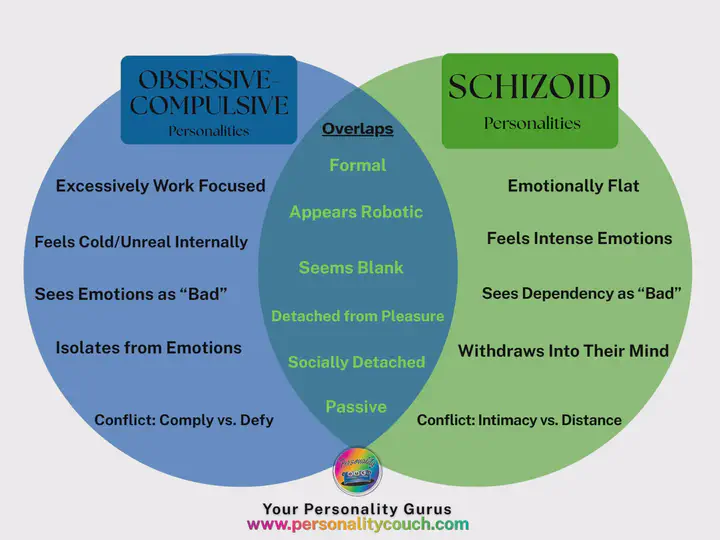
I don’t have space to recap these personalities, so if you need a refresher, check out this blog for schizoid personality disorder and this blog for obsessive-compulsive personality disorder. According to the DSM-5-TR, both obsessive-compulsive personality disorder and schizoids can appear formal and socially detached on the outside. But the difference between them lies in their internal motives. Those with obsessive-compulsive personality disorder have a discomfort with emotions and an excessive focus on work, while those with schizoid personality disorder struggle with intimacy due to fears of intrusion1 3. And remember that the DSM-5-TR takes a deficit-based approach to schizoid personality disorder, focusing on what is lacking, but not on what is actually there2. In contrast, the psychodynamic approach highlights the rich inner world of the schizoid and their focus on fantasy to avoid engulfment3. Nancy McWilliams3 takes a peek at their differing internal dynamics.

Obsessive-Compulsive vs. Schizoid Personalities: Nancy McWilliams 3
I’m not sure I can say it better, so I’ll quote McWilliams here. She says, “The prevalent misconception of the schizoid person as unfeeling may be based on observations of regressed obsessional people who have become wooden and robotic, so deep is the gulf between their cognition and emotion.” Basically, some unhealthy obsessive personalities (usually not compulsive personalities because they are action-based) can isolate from their emotions so much that they can look like schizoid personalities who don’t show the social world their feelings. On the outside, both personalities can look similarly chilly and blank. On the inside, the obsessive personality is hard-core beating down their emotions, while the schizoid personality is experiencing their emotions but not expressing them.

Obsessive-Compulsive vs. Schizoid Personalities: Psychodynamic Diagnostic Manual - 2 4
The PDM-2 captures the key features of those with obsessive-compulsive and schizoid personalities, including their internal dynamics. Starting from birth and continuing through childhood, the obsessive-compulsive child may be more orderly, irritable, and aggressive, perhaps being stubborn and difficult to soothe, struggling more with emotions like guilt, shame, anxiety, fear, and anger. In contrast, the schizoid child is shy, super sensitive, and easily overstimulated, perhaps shrinking away from light, touch, or sound, as they experience overall emotional pain when overstimulated. To handle their distress, they deploy defense mechanisms. For the obsessive-compulsive, this tends to be isolation of affect, reaction formation, intellectualizing, moralizing, and undoing, which serves to suppress the “bad” parts of themselves. The suppressed parts include emotions (click here for details on psychodynamic understanding of obsessive-compulsive personalities). For the schizoid, they use withdrawal (physically, emotionally, or mentally going away and detaching) and intellectualization (click here for details on the psychodynamic understanding of schizoid personality). They learn to hold on to (un)conscious beliefs about the self and others that are essentially unhelpful. The obsessive-compulsive individual believes that they must control emotions because emotions are dangerous. And others aren’t as controlled/meticulous as they are, so they have to control others. This leads to a conflict: do I comply or defy? The schizoid individual believes love and dependency are dangerous and that the social world is intrusive and unsafe because it could consume them. This leads to a conflict between fearing connection versus yearning for connection. Overall, obsessive-compulsives are preoccupied with control, while schizoids are focused on maintaining their separateness.
Obsessive-Compulsive vs. Schizoid Personalities: Theodore Millon 2
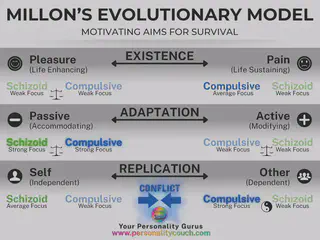
Millon’s evolutionary theory adds an additional perspective to the overlaps and differences between obsessive-compulsive and schizoid personalities. His theory involves three polarities. On the adaptation polarity, both schizoids and compulsives are strongly passive and weakly active. On the existence polarity, both schizoid and compulsive are weak on pleasure, but schizoids are weak on pain, while compulsives are average on pain. The main difference is in the replication polarity where there is independent individuation vs. dependent nurturance. Surprise! This is the self-other polarity. Schizoids are weak on the other polarity dimension, being detached from others. Compulsives are strong on the other polarity, needing to avoid criticism, rejection, and punishment. There’s a people pleasing component. Schizoids are average on self, and compulsives are weak on self, giving up and suppressing their needs to conform and defer…BUT there’s a conflict with the compulsive. They focus on the other at the expense of the self, but hold intense anger and resentment about it. Interestingly, Millon also described a schizoid personality with compulsive features (the affectless schizoid), as well as a compulsive personality with schizoid/avoidant features (the parsimonious constricted), highlighting the different ways these two personalities can blend.

No individual is captured within a textbook definition of personality. If you want to better understand personality in your life, feel free to reach out! If you’re in Virginia (or a PsyPact state), work with us here. If you’re a provider stuck on a case, we also offer consultations for mental health professionals!
References
American Psychiatric Association. (2022). Diagnostic and statistical manual of mental disorders: DSM-5-TR (5th edition, text revision.). https://doi.org/10.1176/appi.books.9780890425787 ↩︎ ↩︎ ↩︎ ↩︎ ↩︎ ↩︎ ↩︎
Millon, T. (2011). Disorders of personality: Introducing a DSM / ICD spectrum from normal to abnormal (3rd edition). John Wiley & Sons, Inc. ↩︎ ↩︎ ↩︎
McWilliams, N. (2011). Psychoanalytic diagnosis: Understanding personality structure in the clinical process (2nd ed.). Guilford Press. ↩︎ ↩︎ ↩︎ ↩︎ ↩︎ ↩︎
Lingiardi, V., & McWilliams, N. (Eds.). (2017). Psychodynamic diagnostic manual: PDM-2 (2nd ed.). The Guilford Press. ↩︎
