Compulsive Personality Subtypes (Millon)


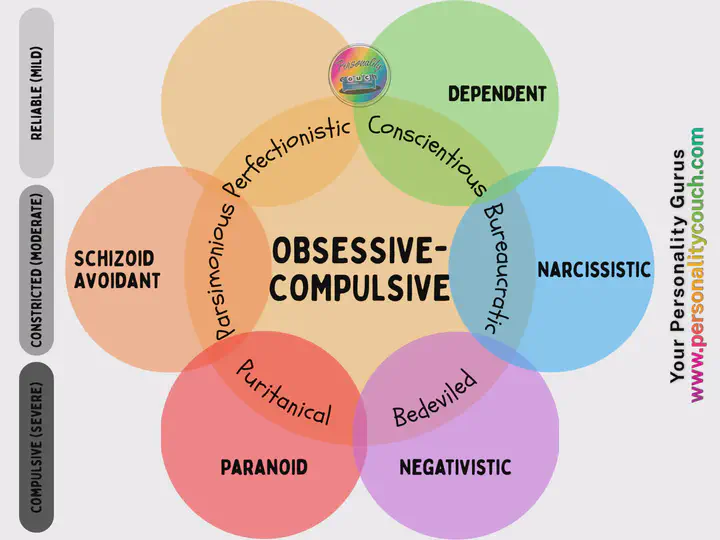
Obsessive-compulsive personality disorder has a straightforward history with most conceptualizations being cohesive. Mild levels of obsessive-compulsive personality disorder are common in societies that value intellect and progression1, so there’s a good chance you or someone you know has some of these traits. It’s also interesting that Millon noted this personality can blend with almost any other personality, and thus there are many possible compulsive subtypes1. Let’s take a look!
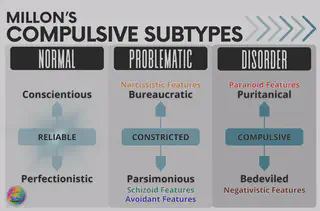
Reliable Personality: Mild - Normal Level 2 1
At the mild level, we have the Reliable Personality where there isn’t as much rigidity and pathological perfectionism, but rather, discipline and organized lifestyles that enhance functioning as they devalue emotions to idealize logic. They get things done correctly, deferring to authority and rules, and they are loyal, moral, and hardworking. Let’s look at the conscientiously reliable and perfectionistically reliable subtypes.
Conscientiously Reliable (Dependent Features) 2 1
The Conscientiously Reliable subtype overlaps with dependent features, being prudent, hardworking, and submissive. They defer to rules, authority, and others’ desires, having difficulty with assertiveness. On the outside, they appear modest, cooperative, and considerate, but this covers deep feelings of inadequacy. They fear making social mistakes, so if things aren’t clear, they become indecisive and rigid due to self-doubt. They would rather depend on powerful others. However, this conflicts with hidden internal, intense rebellious feelings that they have to constrain tightly (lest it come out uncontrolled), resulting in anxiety, rigidity, and isolation from unacceptable emotions. They find it hard to handle disruptions to routines and expectations, so they find structure outside the self, often with religion or other institutions, being pedantic to distract from what’s actually happening inside them.

Perfectionistically Reliable 2 1
The Perfectionistically Reliable subtype is meticulous, pragmatic, diligent, and cautious, seeking clarity for anything ambiguous. They dread taking risks and making mistakes, having a suppressed fear of failure, criticism, and disapproval by authorities. Their pathological perfection works to avoid criticism, which stems from feelings of inadequacy, and exposure of deficits and unacceptable urges. Basically, they focus on the tangible external so they can hide and suppress their internal. They adhere to structured, self-created rules, including perseverance, rigid positivity, and rejection of pleasure. Play is not acceptable. There is a self-imposed pressure to perform and achieve, which can lead to negative consequences like being cold, pedantic, close-minded, and insensitive to others’ views. They can thrive in formal jobs, but struggle with intimate relationships.
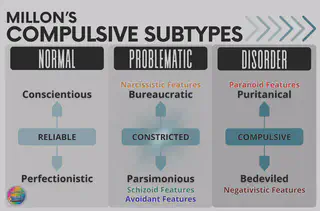
Constricted Personality: Moderate - Problematic Level 2 1
Mild subtypes can disintegrate into moderate severity if conforming becomes too stressful, becoming more constricted and unable to release inner tensions. They may display emotional outbursts or experience somatic symptoms. Millon describes the bureaucratically constricted and the parsimoniously constricted.
Bureaucratically Constricted (Narcissistic Features) 2 1
The Bureaucratically Constricted subtype overlaps with narcissistic features, being close-minded, highhanded, and intrusive. They align themselves with time-established, structured institutions (e.g., university, church, police) to feel comfort and strength, instead of oppression and anger. Belonging in a group helps their self-esteem and supports their decisiveness and action. The guilt/anxiety stemming from unacceptable but constrained impulses are dispelled by putting responsibility of action onto the organization, to which they become very dependable and loyal. They give up individuality to be part of a system. They rigidly and pedantically do what they’re told, so they can’t be punished, resulting in feeling protected. It gives them a sense of purpose, identity, and value. Their narcissistic pride and self-importance in their belonging is only surface level and is not part of their core inner workings.

Parsimoniously Constricted (Schizoid, Avoidant Features) 2 1
The Parsimoniously Constricted subtype overlaps with schizoid and avoidant features and is in line with Fromm’s hoarding orientation, as they place a protective wall between the self and external world. Inside that wall, they hold tight to their possessions, money, and privacy to avoid any potential loss. They don’t try to take from others, just protect their own stuff. They overlap with avoidant personality in their avoidance of others and hypervigilance to others’ potential taking of their resources. But they protect against intrusion so that their internal emptiness, rebellious desires, and anger are not exposed. Millon states, “Respect is a way of maintaining distance, then, a means of hiding what the rigid types must keep from others and from themselves” (Millon, 2011, p. 503).
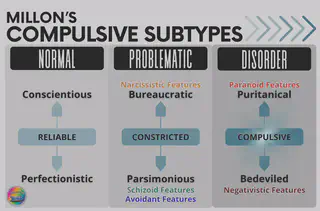
Compulsive Personality: Severe - Disorder Level 2 1
The moderate subtypes can disintegrate easily into the severe level due to increasing difficulty handling their desire to be oppositional. This means we’re possibly in Obsessive-Compulsive Personality Disorder territory where they become even more constrained and rigid (puritanical compulsive) or even more overwhelmed by internal conflict (bedeviled compulsive).
Puritanical Compulsive (Paranoid Features) 2 1
The Puritanical Compulsive subtype showcases paranoid features, viewing the world through a lens of moral absolutes. On the outside, they look highly moralistic, self-righteous, and conforming to authority, which is usually driven by a fear of condemnation. However, on the inside, they struggle with unwanted impulses, anger, and resentment that they view as unacceptable, so they intensely suppress it. This suppression creates ongoing tension, hostility, and insecurity…which they want to release but can’t because they fear rejection/punishment. Sometimes, this can show up in psychosomatic symptoms. The conflict either leaks out (i.e., outbursts, arguments, criticism, judgment) or is countered (i.e., constraint, rigid adherence to rules, morality). In other words, they fluctuate between punishing the self or others. In extreme cases, they can justify cruelty or aggression as morally necessary, transforming their fear of condemnation into a drive to judge and punish others (e.g., kamakaze).

Bedeviled Compulsive (Negativistic Features) 2 1
The Bedeviled Compulsive subtype showcases negativistic features appearing highly controlled and compliant on the outside because they are suppressing their oppositional feelings. Inside though, they struggle with anxiety, indecision, self-doubt, and confusion about their identity and desires. They are tormented by a deep conflict between obedience and defiance, which can lead to procrastination, exhaustion, and emotional turmoil. To handle overwhelming feelings, they may deploy coping measures like obsessions, compulsions, or self-punishing behaviors. In more severe cases, they may fear that they are losing control of their morality or mind, sometimes feeling possessed or on the verge of psychosis.
Do any of these speak to you? Compulsive personality dynamics and disorder can be difficult to separate from other dysfunction and other personalities. If you want to dive into your own OCPD dynamics, therapy and/or psychological testing can help! If you’re in Virginia (or a PsyPact state), check out Quest Psychological and Counseling Services for available services. If you’re a provider stuck on a case, we also offer consultations for mental health professionals!
References
Millon, T. (2011). Disorders of personality: Introducing a DSM / ICD spectrum from normal to abnormal (3rd edition). John Wiley & Sons, Inc. ↩︎ ↩︎ ↩︎ ↩︎ ↩︎ ↩︎ ↩︎ ↩︎ ↩︎ ↩︎ ↩︎
Millon, T., Grossman, S., Millon, C., Meagher, S., & Ramnath, R. (Eds.). (2004). Personality disorders in modern life (2nd ed.). Wiley. ↩︎ ↩︎ ↩︎ ↩︎ ↩︎ ↩︎ ↩︎ ↩︎ ↩︎
