Obsessive-Compulsive Personality Disorder (F60.5) Diagnostic Criteria


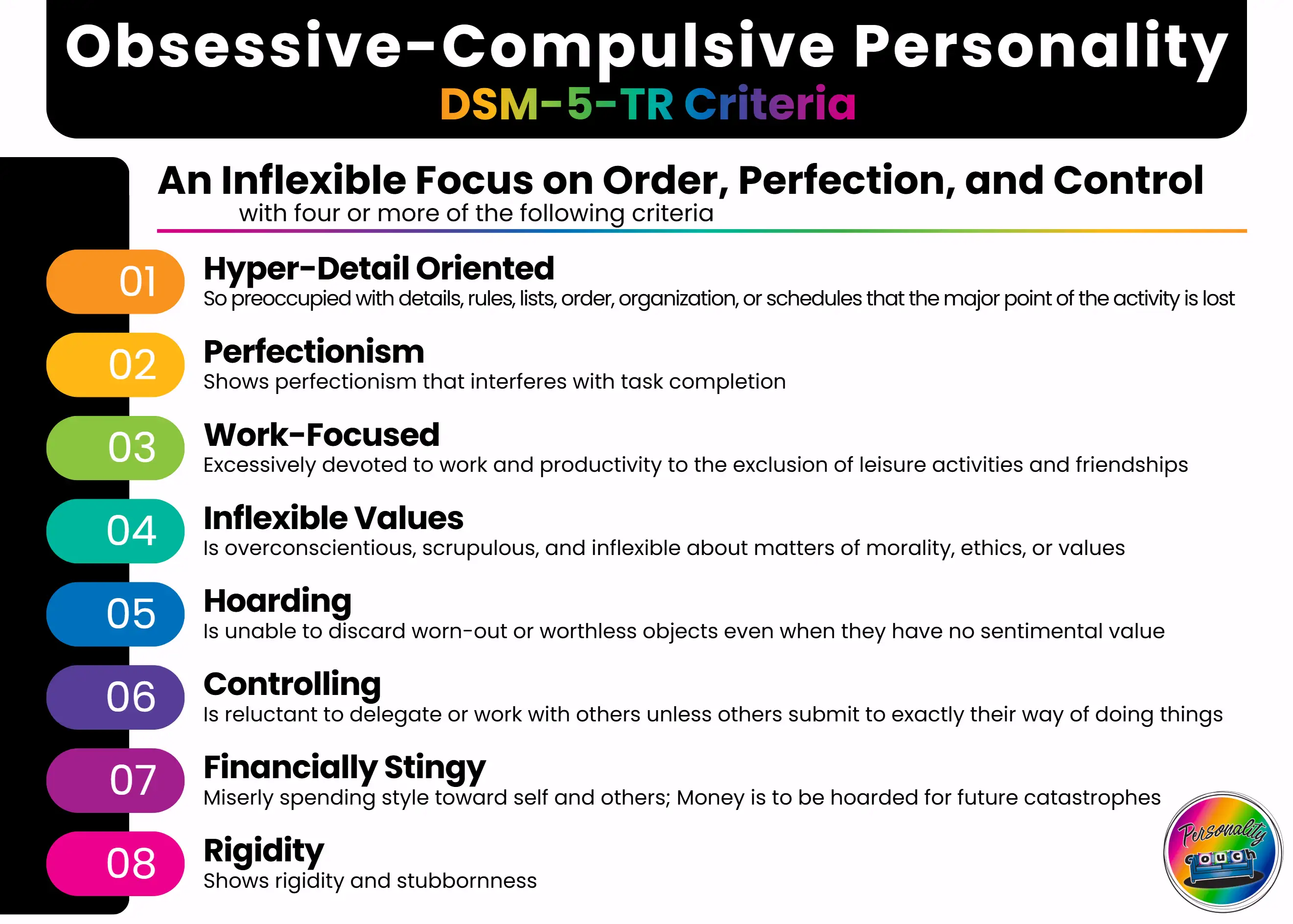
Obsessive-compulsive personality disorder has a fairly straightforward history, as many early theorists noticed a personality focused on being orderly and perfect. Originally, the term “Zwang” was used to describe constricted thinking and compulsivity. Later, it was translated into many different words and meanings, such as obsession (London) and compulsion (New York). The term anankastic was eventually used to describe the obsessive-compulsive personality, which is still used in the ICD today, but not the DSM. So what are the present DSM criteria for obsessive-compulsive personality disorder?
| Note: Text in these boxes are the exact words from DSM-5-TR1 |
|---|
Obsessive-Compulsive Personality Disorder Criteria
| “A pervasive pattern of preoccupation with orderliness, perfectionism, and mental and interpersonal control, at the expense of flexibility, openness, and efficiency, beginning by early adulthood and present in a variety of contexts, as indicated by four (or more) of the following2:” (p. 772) |
|---|
Perfectionism is a common thing nowadays, but obsessive-compulsive personality disorder isn’t just regular perfectionism. It’s perfectionism and inflexibility on steroids, geared both toward the self and others, resulting in distress and dysfunction. Like all personality disorders, it has to be present earlier in life and across settings. The pattern of perfectionism must be paired with at least four out of the eight criteria below.
Hyper-Detail Oriented: Obsessive-Compulsive Personality Disorder (Criterion 1)
| “Is preoccupied with details, rules, lists, order, organization, or schedules to the extent that the major point of the activity is lost2.” (p. 772) |
|---|
In order to maintain a sense of control and manage anxiety, those with obsessive-compulsive personality disorder are HYPER-detail oriented, being excessively careful, attentive, and consumed with trivial parts of tasks to a point where the task itself is no longer the focus. If situations aren’t clear, they can’t prioritize or make decisions, often not starting any task at all. Their time management is poor; they procrastinate; and they ignore the consequences of inconveniencing others.

Perfectionism: Obsessive-Compulsive Personality Disorder (Criterion 2)
| “Shows perfectionism that interferes with task completion (e.g., is unable to complete a project because his or her own overly strict standards are not met)2.” (p. 772) |
|---|
This is pathological perfectionism imposed on both the self and others that results in dysfunction and distress. They miss deadlines or don’t complete projects because it’s not perfect, even though they’ve worked all night and skipped meals. It’s not a lack of trying, but over-trying, which also means other responsibilities are ignored during this process, such as chores and self-care.
Work-Focused: Obsessive-Compulsive Personality Disorder (Criterion 3)
| “Is excessively devoted to work and productivity to the exclusion of leisure activities and friendships (not accounted for by obvious economic necessity)2.” (p. 772) |
|---|
The cliche “all work and no play” is accurate here, as they have difficulty relaxing or engaging in pleasurable activities (unless they bring work with them so they don’t “waste” time). Social interactions and hobbies are focused on perfect performance, not fun. They can impose this on others, especially children, turning play into something that must be done “correctly.” Additionally, their emotions are formal, intellectual, and constrained.

Inflexible Values: Obsessive-Compulsive Personality Disorder (Criterion 4)
| “Is overconscientious, scrupulous, and inflexible about matters of morality, ethics, or values (not accounted for by cultural or religious identification)2.” (p. 772) |
|---|
Individuals with obsessive-compulsive personality disorder hold themselves (and others) to very high standards. They defer to rules and authority rigidly. Because of this, they can be quite self-critical and super judgmental of others’ mistakes. There is a legalistic, literal compliance and conformity to the rules with no flexibility. There’s no bending the rules, no matter the circumstances. For example, no matter the situation, they won’t give a dollar to a friend short of the money needed for a bus fare because it would be harmful for their friend’s character development, or because “neither a borrower nor a lender be.”
Hoarding: Obsessive-Compulsive Personality Disorder (Criterion 5)
| “Is unable to discard worn-out or worthless objects even when they have no sentimental value2.” (p. 773) |
|---|
They might describe themselves as a “pack rat,” knowing they hoard things they may need later or believe they will “get to” later (but they won’t). They need to feel prepared and avoid being wasteful, and they will become upset if someone tries to clean out their clutter. Others might complain about their clutter, but it is not the same as hoarding disorder.

Controlling: Obsessive-Compulsive Personality Disorder (Criterion 6)
| “Is reluctant to delegate tasks or to work with others unless they submit to exactly his or her way of doing things2.” (p. 773) |
|---|
Individuals with obsessive-compulsive personality disorder have difficulty letting others be involved in tasks, either by delegation or cooperation, because they must have things done correctly…and only they can do it exactly how it needs to be done. Literally, it’s “my way or the highway.” They unreasonably micromanage and don’t get it when others become annoyed with them or when others desire to do things differently. They also tend to stubbornly reject help, even when it would benefit them. This can lead to significant hardships in a work environment.
Financially Stingy: Obsessive-Compulsive Personality Disorder (Criterion 7)
| “Adopts a miserly spending style toward both self and others; money is viewed as something to be hoarded for future catastrophes2.” (p. 773) |
|---|
Those with obsessive-compulsive personality disorder can be very stingy with money. They want to be prepared for potential future disasters, so they are super strict with spending and basically hoard their finances. They live way below their financial means, having a hard time spending money on others as well as themselves.

Rigidity: Obsessive-Compulsive Personality Disorder (Criterion 8)
| “Shows rigidity and stubbornness2.” (p. 773) |
|---|
I feel like this has been captured throughout the other criteria, but it’s reiterated here. They have difficulty perspective-taking because they’re so focused on the one right way of doing things and preoccupied with details that they can’t handle or consider changes to their plan, their routine, or their own manner of doing things. Others can get pretty annoyed with them due to their consistent rigidity. Even when there is self-awareness that compromise might be helpful, they can still stubbornly refuse to do so…because it’s the “the principle of the thing.”
Interestingly, the criteria involved in obsessive-compulsive personality disorder has essentially remained the same since 1994, perhaps mirroring the resistance to change. 🤔 If you or anyone you know are experiencing any of these symptoms, professional help is available! If you’re in Virginia, Maryland, DC, Pennsylvania, or North Carolina, check out our private practice, Quest Psychological and Counseling Services for available services. If you’re a provider stuck on a case, we also offer consultations for mental health professionals!
References
Blaney, P. H., Krueger, R. F., Millon, T. (Eds.). (2014). Oxford textbook of psychopathology (3rd ed.). Oxford University Press. ↩︎
American Psychiatric Association. (2022). Diagnostic and statistical manual of mental disorders: DSM-5-TR (5th edition, text revision.). https://doi.org/10.1176/appi.books.9780890425787 ↩︎ ↩︎ ↩︎ ↩︎ ↩︎ ↩︎ ↩︎ ↩︎ ↩︎
