Histrionic vs. Borderline


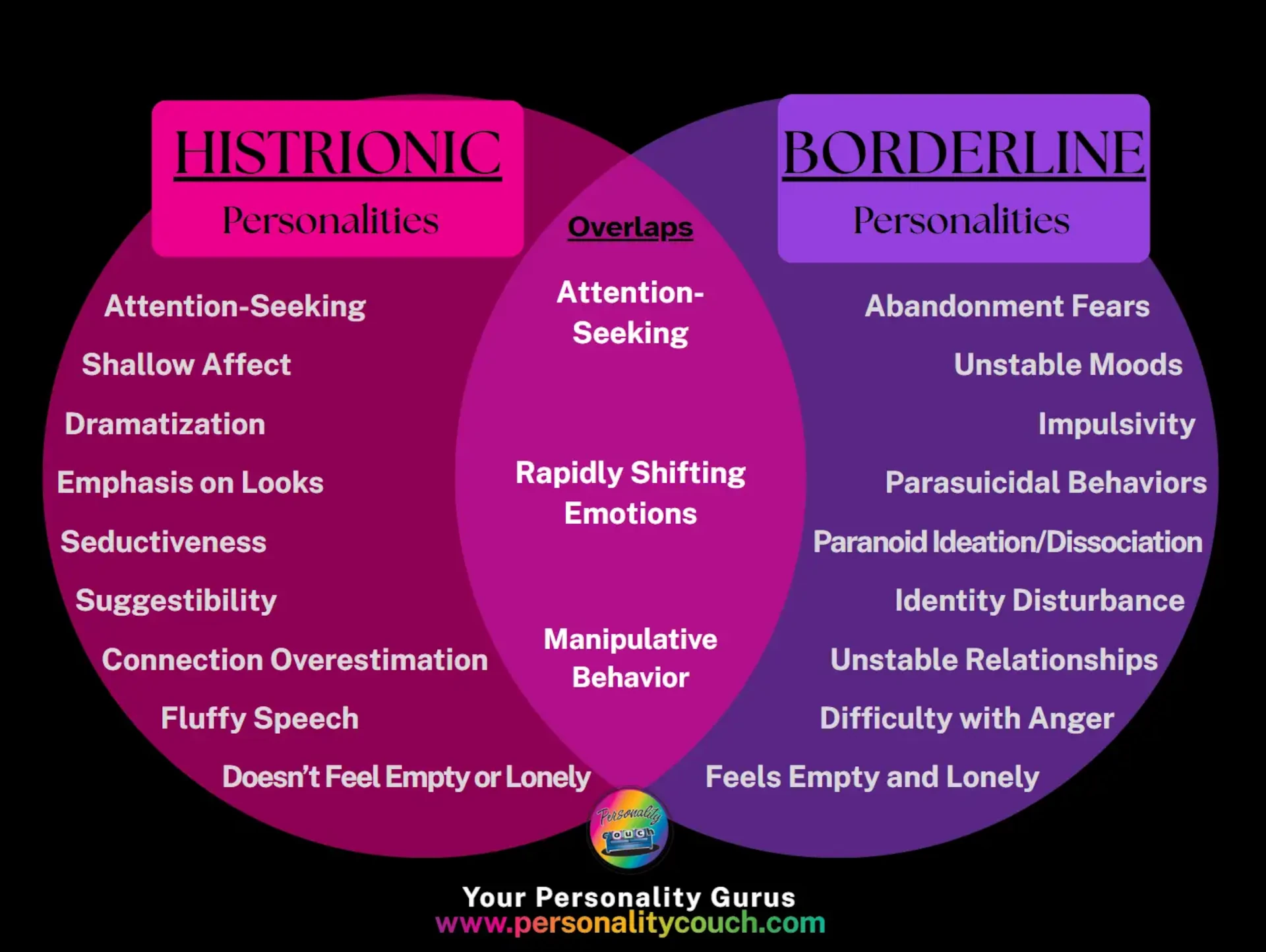
While borderline personality disorder didn’t show up in the DSM until 19801, histrionic (hysterical) personality disorder made an appearance in the DSM-II in 19682. However, both disorders have super interesting histories that involve confusion of terms, misunderstanding, and stigma. (See this blog for borderline history and this one for histrionic history). Borderline used to be a term to describe a personality organization, meaning a level of health or severity3. Histrionic stems from the term hysterical, which was used in the medical field to describe conditions in a female that didn’t fit neatly into a category. In the DSM-III-R4, criteria from histrionic was actually deleted to better differentiate it from borderline4 5. Currently, there’s a lot of overlap between these two personalities6 7, but histrionic is often overlooked and diagnosed as borderline. Let’s take a deeper look!
For more information on borderline personality according to the DSM, click here. To better understand the histrionic personality according to the DSM click here, and for more in depth information on histrionic personality, click here.
Histrionic vs. Borderline Personality Disorders: The DSM-5-TR Differential Diagnosis6
The DSM-5-TR acknowledges that both borderline and histrionic personality disorders can involve “attention seeking, manipulative behavior, and rapidly shifting emotions,” but borderline personality disorder can be “distinguished by self-destructiveness, angry disruptions in close relationships, and chronic feelings of deep emptiness and identity disturbance…and loneliness” (p.756, 759). It also notes that histrionic personality disorder has high rates of comorbidity with borderline, while borderline “frequently co-occurs with the other personality disorders” (p. 757).

Histrionic vs. Borderline Personality: The Psychodynamic Understanding
The psychodynamic perspective on borderline personality disorder helps us understand tremendously the mix up between histrionic and borderline. Originally, borderline was used to describe a personality organization of health. It was the in-between space where one was not neurotic, but also not psychotic. The borderline space could fluctuate between the two states. It’s basically a state of melting (See Understanding Neurotic, Psychotic and Borderline blog). Psychodynamic theory believes our current understanding of borderline personality disorder is actually the histrionic personality at the borderline organizational level 8 9 3. This matches with the DSM’s proposal that histrionics have less impairment in comparison to other personalities6…because they’re at the neurotic level of organization, better able to defend against pain and falling apart.
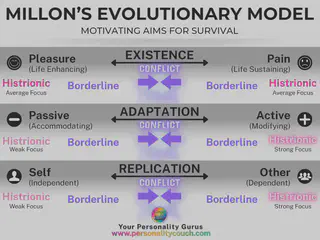
Histrionic vs. Borderline Personality: Millon’s Perspective5
Millon’s theory is super helpful because even though he doesn’t use the term borderline organization, he does propose there are several personalities that have defective structures - that is, their structure can fall apart and start unraveling: Borderline, Schizotypal, and Paranoid. Thus, it is very possible that a histrionic personality can disintegrate into borderline personality disorder. But the inverse is not necessarily true.
Another part of Millon’s theory that helps us significantly understand the similarities and differences between histrionic and borderline (and all cluster Bs), is his focus on polarities. One polarity is essentially energy and how one adapts to their environment. It’s the passive-active polarity in which you can either passively accommodate to the environment or actively modify your environment. The other polarity that’s helpful here is the self-other polarity in which you either seek self individuation or focus on nurturance in connection with others.
Then Million talks about the interpersonally imbalanced spectra containing four different personalities…all of which can overlap with and be confused with histrionic personality. These interpersonally imbalanced personalities include two that are self-focused: narcissistic and antisocial; and two that are other focused: dependent and histrionic.
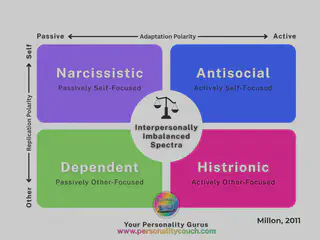
But we’re talking about histrionic and borderline here…and borderline doesn’t fit with the interpersonally imbalanced because they experience conflict among all of their polarities: sometimes being passive, sometimes bing active; sometimes self-oriented, sometimes other-oriented. And guess which personalities often overlap and disintegrate into borderline and can get all mixed up? The cluster Bs AND dependent! So all of these personalities could fall apart into borderline personality.
That being said, what are your thoughts? Do you believe that our current understanding of borderline personality disorder is a histrionic personality at the borderline structural level? If you want to better understand personality in your life, feel free to reach out! If you’re in Virginia (or a PsyPact state), work with us here. If you’re a provider stuck on a case, we also offer consultations for mental health professionals!
References
American Psychiatric Association. (1980). Diagnostic and statistical manual of mental disorders: DSM-III (3rd ed.). https://doi.org/10.1176/appi.books.9780521315289.dsm-iii ↩︎
American Psychiatric Association. (1968). Diagnostic and statistical manual of mental disorders: DSM-II (2nd ed.). https://doi.org/10.1176/appi.books.9780890420355.dsm-ii ↩︎
McWilliams, N. (2011). Psychoanalytic diagnosis: Understanding personality structure in the clinical process (2nd ed.). Guilford Press. ↩︎ ↩︎
American Psychiatric Association. (1987). Diagnostic and statistical manual of mental disorders: DSM-III-R (3rd edition, revised.). https://doi.org/10.1176/appi.books.9780890420188.dsm-iii-r ↩︎ ↩︎
Millon, T. (2011). Disorders of personality: Introducing a DSM / ICD spectrum from normal to abnormal (3rd edition). John Wiley & Sons, Inc. ↩︎ ↩︎
American Psychiatric Association. (2022). Diagnostic and statistical manual of mental disorders: DSM-5-TR (5th edition, text revision.). https://doi.org/10.1176/appi.books.9780890425787 ↩︎ ↩︎ ↩︎
Blagov, P. S., & Westen, D. (2008). Questioning the coherence of histrionic personality disorder: Borderline and hysterical personality subtypes in adults and adolescents. The Journal of Nervous and Mental Disease, 196(11), 785-797. https://doi.org/10.1097/NMD.0b013e31818b502d ↩︎
Kernberg, O. F. (1985). Borderline conditions and pathological narcissism. Rowman & Littlefield Publishers, Inc. ↩︎
Lingiardi, V., & McWilliams, N. (Eds.). (2017). Psychodynamic diagnostic manual: PDM-2 (2nd ed.). The Guilford Press. ↩︎
