Antisocial Personality vs. Narcissistic Personality


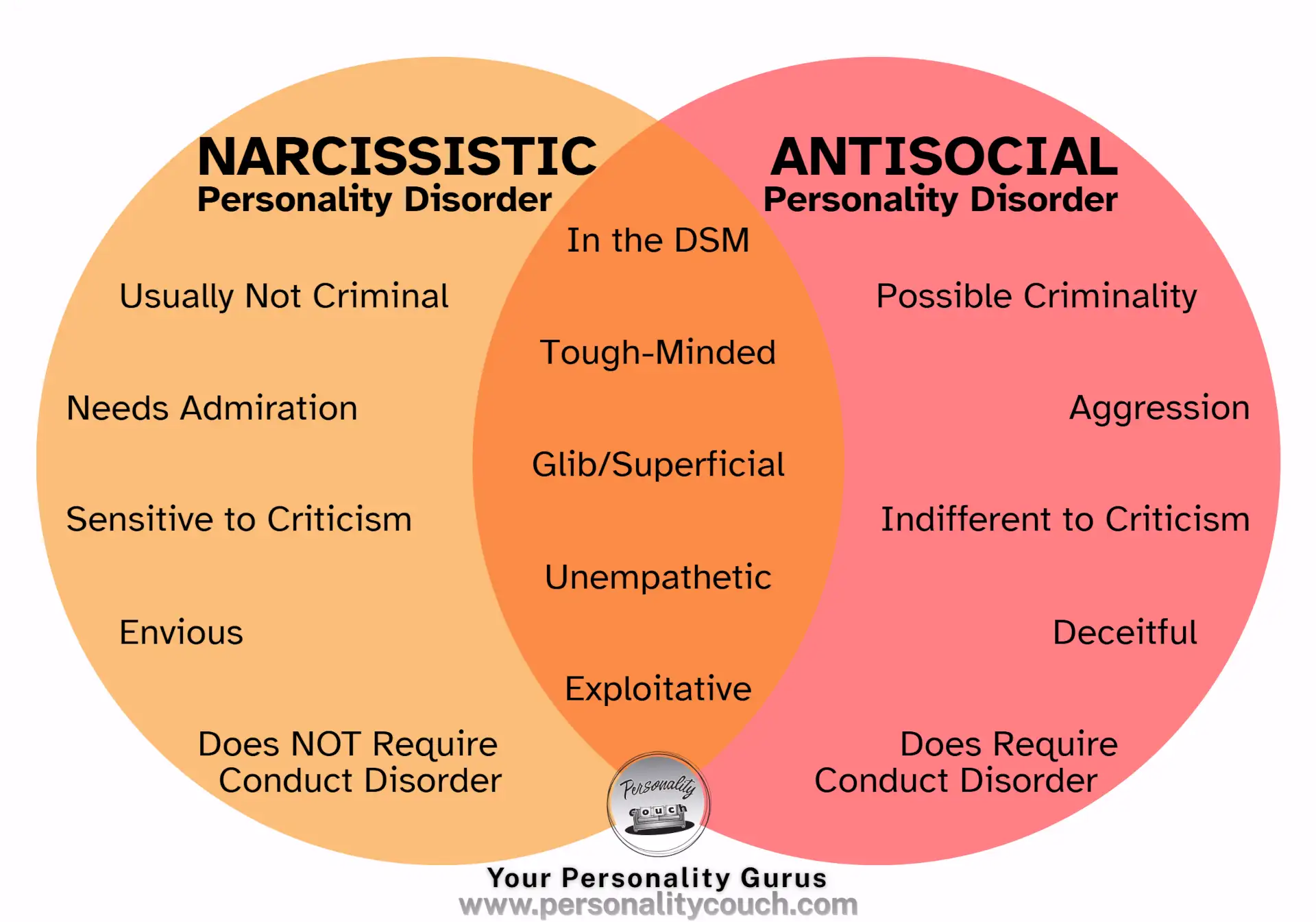
Antisocial personality disorder and narcissistic personality disorder are tough to differentiate because they often overlap, yet have separate and distinct characteristics1 2 3 4. Additionally, narcissism does not have to be at a level of personality disorder. Narcissism is also a trait5 2 3. Further, antisocial does not have to be at a level of disordered personality. Antisocial can simply be behaviors6 2 4. It can get quite confusing, so let’s dive into the similarities and differences of antisocial and narcissistic dynamics.
Antisocial and Narcisstic in the DSM1
In the DSM-5-TR, antisocial personality disorder and narcissistic personality disorder do not have any criteria that overtly overlap. However, antisocial personality disorder’s associated features include arrogance, charm, and lack of empathy - all of which are part of narcissistic personality disorder. Also, the DSM-5-TR specifically notes both share traits such as being “tough-minded, glib, superficial, exploitative, and unempathic.” However, antisocials are more impulsive, aggressive, deceitful, and indifferent, with a history of conduct disorder and possible adult criminality. Whereas, narcissists are more envious, needing more admiration from others and being more sensitive to others’ criticism and reactions. They usually don’t have conduct disorder or adult criminality. Overall, it seems that antisocial personality disorder exudes the more severe behavior of narcissistic personality disorder…which aligns with Michael Stone’s work below.
Stone’s Spectrum4 & Hare’s Checklist6
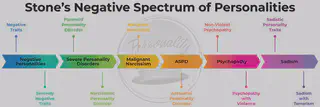
Michael Stone’s spectrum of negative personality includes both narcissistic and antisocial personality disorders, sandwiching malignant narcissism4. (See Episode 27: What’s Worse Than a Narcissist? The Baddest of Them All and its corresponding blog for more in depth information). Understanding malignant narcissism is helpful to see the overlap between narcissistic and antisocial. Malignant narcissism was coined by Otto Kernberg2 (super cool and smart psychiatrist) who defined it as a narcissistic core, antisocial behavior, paranoid orientation, and aggression/sadism2 4. You can find more about Kernberg’s malignant narcissism here. Pulling in another theory, Robert Hare, a forensic psychologist who studies psychopathy, created a Psychopathy Checklist - Revised (PCL-R) that originally had two factors6. Guess what?! One factor correlates with narcissistic personality disorder and the other correlates with antisocial personality disorder6 3 🤜🫳🎤! …But that’s not even the best way to understand the differences between the two. For that, I like Millon’s theory.
Millon’s Passive Narcissist vs. Active Antisocial3
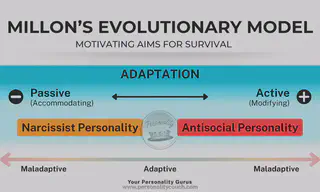
There’s no question that narcissistic and antisocial personality disorders can be hard to differentiate. Antisocial overlaps most frequently with narcissistic and sadistic personalities; and narcissistic overlaps most with antisocial and histrionic personalities. They are both exploitative, unempathetic, and self-focused, turning to the self to fulfill their needs and find gratification. But how are they different? It’s mostly their difference in adapting to life. Antisocials are active, focusing on modifying their environment, whereas narcissists are passive, focusing on finding accommodations. Narcissists have a passive, core belief of superiority and entitlement. They think, “Things should just come to me, because I’m great and deserve great things.” Antisocials are active in that they work for their superiority. They think, “I got ripped off in life so I have to take what I’m owed. I deserve more because life dealt me a bad hand.”
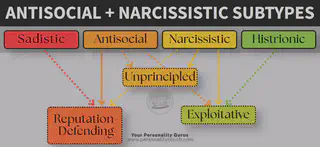
Millon’s Narcissistic & Antisocial Overlapping Subtypes3
Remember how antisocial overlaps most with narcissistic and sadistic, and narcissistic overlaps most with antisocial and histrionic? Millon has a few subtypes that showcase this. The Reputation-Defending Devious is an antisocial personality with narcissistic and sadistic features. They pursue status and reputation, a seemingly narcissistic venture; however, they do so for power, not image. And, they actively take what they feel they are owed, not just passively feeling it should be provided to them. They present as tough, invincible, and unconquerable, often showing up at the “top” of their group, be it Wall Street, business, gangs, politics, etc.
The Exploitative Egotist is a narcissistic personality with antisocial and histrionic features. In their superiority pursuit, they attempt to gain self-worth by seducing others in games of sexual exploits, which only last a day to a few weeks because it’s a very shallow intimacy. They are a phony type of confident and cleverly deceptive, acting without conscience because they are obviously above everything. They can’t put the money where their mouth is, yet fear being exposed because of their underlying inadequacy.
The Unprincipled Narcissist is a narcissistic personality with antisocial features. They present with shallow charm and false toughness, which easily cracks to show the arrogant amorality underneath. They enjoy the dynamics of exploiting others before others do it to them, contemptuously conning others and being vindictive. They expect to be treated as special, still maintaining the core of narcissistic passive entitlement.

There’s a couple more I found helpful to understand. Though not a mixture of narcissistic and antisocial, Millon states that the Compensatory Narcissistic Personality Disorder tries to compensate for deprivations in childhood (like the antisocial), but they try to create an image of superiority instead of actively taking power. Personally, I had trouble understanding how the Covetous Aggrandizing (antisocial) did NOT overlap with narcissistic personality. The Covetous Antisocial takes and takes and takes, sometimes displaying what they take in ostentatious ways. It sounds narcissistic, but because they actively acquire their possessions and power, and because they are never satiated, they are the prototypical antisocial personality.
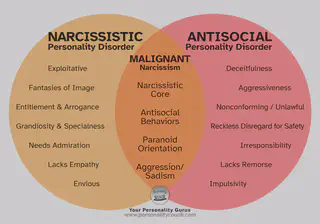
In sum, antisocials and narcissists are self-focused, unempathetic, and exploitative. If I were to use my own words to describe the main difference between both, I would say: Antisocials don’t give a 💩 and actively take power, but narcissists are sensitive to ego wounds and passively feel they should be provided their needs. In real life, there aren’t textbook-clear divisions of antisocials and narcissists, and malignant narcissism may be the grey area in-between.
It’s hard to parse all this out! If you want to better understand these dynamics in yourself or others, therapy and/or psychological testing can help! If you’re in Virginia (or a PsyPact state), check out our private practice, Quest Psychological and Counseling Services for available services. If you’re a provider stuck on a case, we also offer consultations for mental health professionals!
References
American Psychiatric Association. (2022). Diagnostic and statistical manual of mental disorders: DSM-5-TR (5th edition, text revision.). https://doi.org/10.1176/appi.books.9780890425787 ↩︎ ↩︎
Kernberg, O. F. (1984). Severe personality disorders: Psychotherapeutic strategies. Yale University Press. ↩︎ ↩︎ ↩︎ ↩︎ ↩︎
Millon, T. (2011). Disorders of personality: Introducing a DSM / ICD spectrum from normal to abnormal (3rd edition). John Wiley & Sons, Inc. ↩︎ ↩︎ ↩︎ ↩︎ ↩︎
Stone, M. H. (2018). The place of psychopathy along the spectrum of negative personality types. Contemporary Psychoanalysis, 54(1), 161–182. https://doi.org/10.1080/00107530.2017.1420376 ↩︎ ↩︎ ↩︎ ↩︎ ↩︎
Akhtar, S. (1992). Broken structures: Severe personality disorders and their treatment. Jason Aronson, Inc. ↩︎
Hare, R. D., Harpur, T. J., Hakstian, A. R., Forth, A. E., Hart, S. D., & Newman, J. P. (1990). The revised Psychopathy Checklist: Reliability and factor structure. Psychological Assessment: A Journal of Consulting and Clinical Psychology, 2(3), 338-341. https://doi.org/10.1037/1040-3590.2.3.338 ↩︎ ↩︎ ↩︎ ↩︎
